
My plugin is not the only tool that cleans up the metallic sound of AI music, and services that detect AI music are multiplying fast. Parts 1 and 2 covered why and how I built DeMetal AI and what went wrong the first time I used it. This part widens the view to what similar tools and services are doing now, and what their numbers say.
What similar services are doing
After building it, I looked around the market. It splits into two camps: tools that clean up AI music and services that detect it.
Cleanup tools
| Name | Form | What it does | Worth noting |
|---|---|---|---|
| Intrect de-artifact | Plugin · $149 | Removes AI artifacts and codec residue · preset for Suno v6 | Compare original, cleaned and removed sound · says it is not a detection-passing tool |
| Zynaptiq UNCHIRP | Plugin | Reduces the chirpy fizz of low-bitrate MP3s | Most effective on Suno shimmer in a community comparison (sides only) |
| iZotope RX | Restoration software | Cleans up clicks, crackle and reverb | Users share ways to apply it stem by stem |
| Suno Remaster | Built into Suno | Regenerates the texture of a song | Three strength levels · processed inside Suno |
| Shimmer (henricksmedia) | Free program | Removes shimmer, then masters | Own license, not open source, since September 24, 2026 |
| Burnish · MasteringOne · Sunofix · Neural Analog | Web services | Fixes what it measures, then masters · matches commercial references | Burnish and Sunofix say they do not guarantee detection evasion or distributor approval |
| DeMetal AI (this article) | FL Studio plugin (Mac) | Cleans metallic ring, shimmer and noise in six bands · Capture Original | Does not target the detection fingerprint · personal experiment |
The same search results also turn up services of a different kind: ones advertising that they will get your track past detection, with lines like "98% judged human-made," ones promising to get you through a distributor's AI check, and ones claiming to strip AI certificates and watermarks. Sound improvement and detection evasion are being sold on the same screen in the same tone of voice. That is the uncomfortable side of this market.
The line blurs inside a single company too. Intrect, the maker of de-artifact, also offers an AI music detector. It notes that after cleanup, a track's score on its own detector may go up or down. The detector and the eraser sit side by side on the same shelf.
Detection services and platform labels
The detection side has grown much bigger. Deezer receives about 90,000 fully AI-generated tracks a day. On busy days, that is more than half of everything uploaded. Yet these tracks account for only 1 to 3% of all streams. In 2025, Deezer judged up to 85% of the streams on AI tracks to be fraudulent and did not pay royalties on them. That is the trace of machines playing songs nobody listens to, in an attempt to pull out royalties.
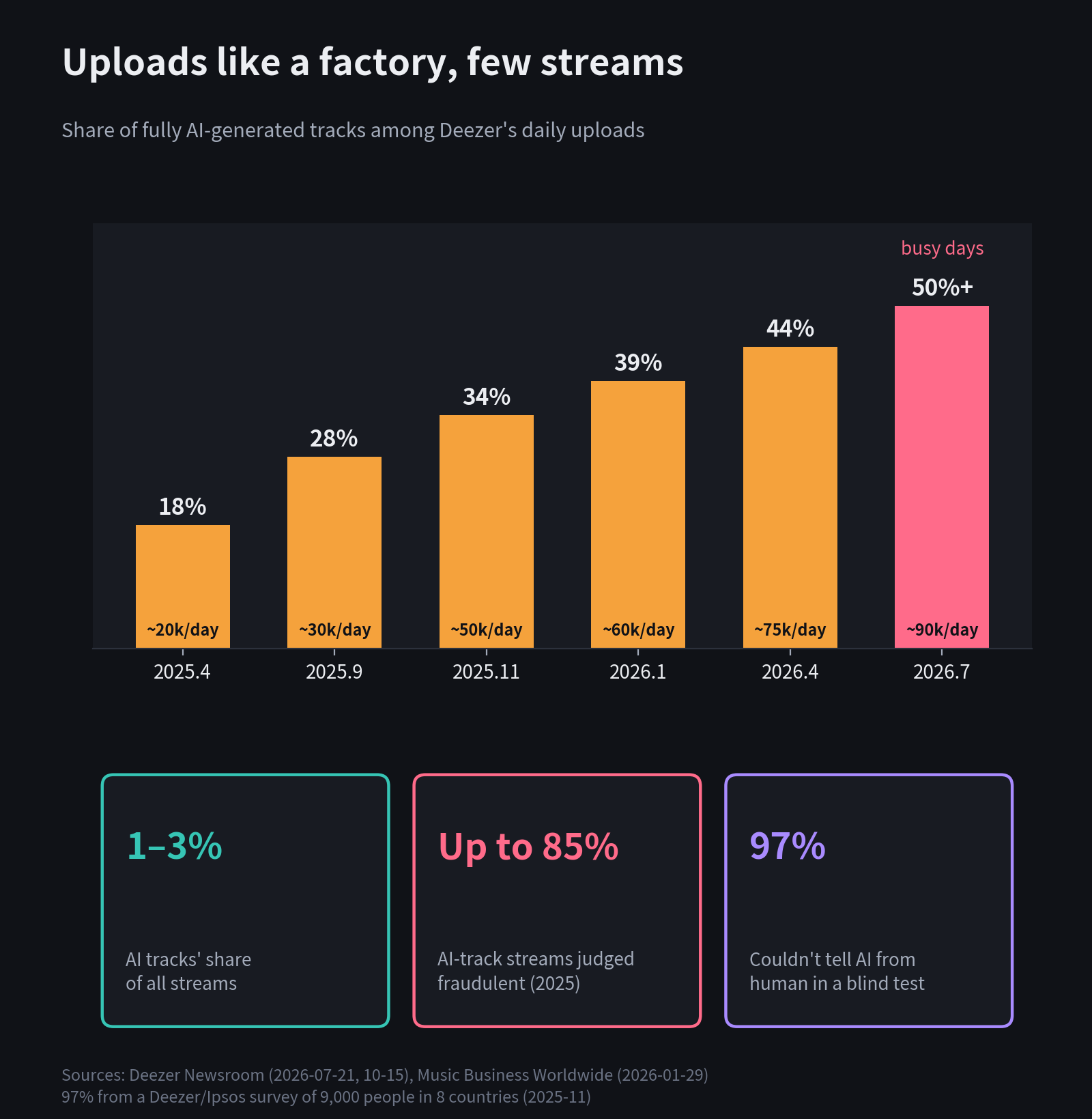
Fraud for money has also surfaced in a real case. In the United States, Michael Smith was charged in 2024 with using bots to play AI-generated songs and collect royalties. He pleaded guilty in March 2026 and in early October was sentenced to 18 months in prison and forfeiture of about $8.09 million. On October 20, Spotify said it had pulled more than 50 million tracks out of its recommendations this year. It added that tracks it suspects are AI-made are ten times more likely to get fewer than 1,000 plays a year.
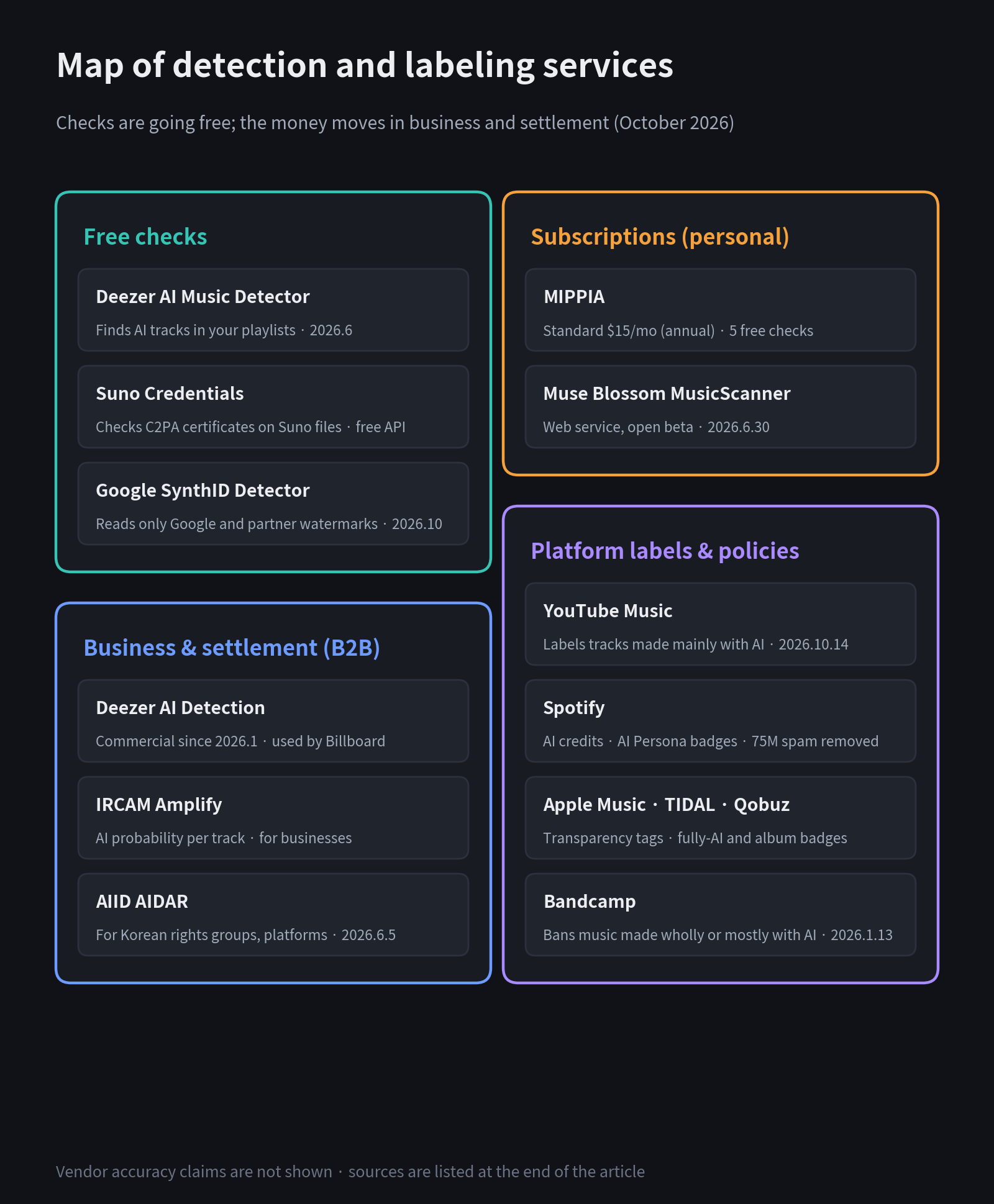
Platforms have started labeling, too. Deezer tags AI tracks and keeps them out of its recommendations; since January 2025 it has excluded more than 42 million AI tracks. YouTube Music began labeling tracks made primarily with AI on October 14, 2026. Spotify removed 75 million spam tracks in the 12 months to September 2025 and introduced AI credits and "AI Persona" badges. Apple Music has started accepting transparency tags. TIDAL badges fully AI tracks and pays no royalties on them, and Qobuz adds AI badges to albums. Bandcamp does not accept music made wholly or in substantial part by AI at all.
Detection technology has become a product in its own right. Deezer has been selling its detection tool to other companies since January 2026, and Billboard uses it for its charts. In Korea, services such as AIID's AIDAR, Muse Blossom's MusicScanner and MIPPIA have launched. Meanwhile, checking is quickly becoming free. Deezer will tell you at no cost how much AI music is mixed into your playlists. Suno released a free tool that checks the digital certificates on its own files, and Google opened a tool to the public that checks for watermarks from Google and its partners.
Korea is still looking for proof
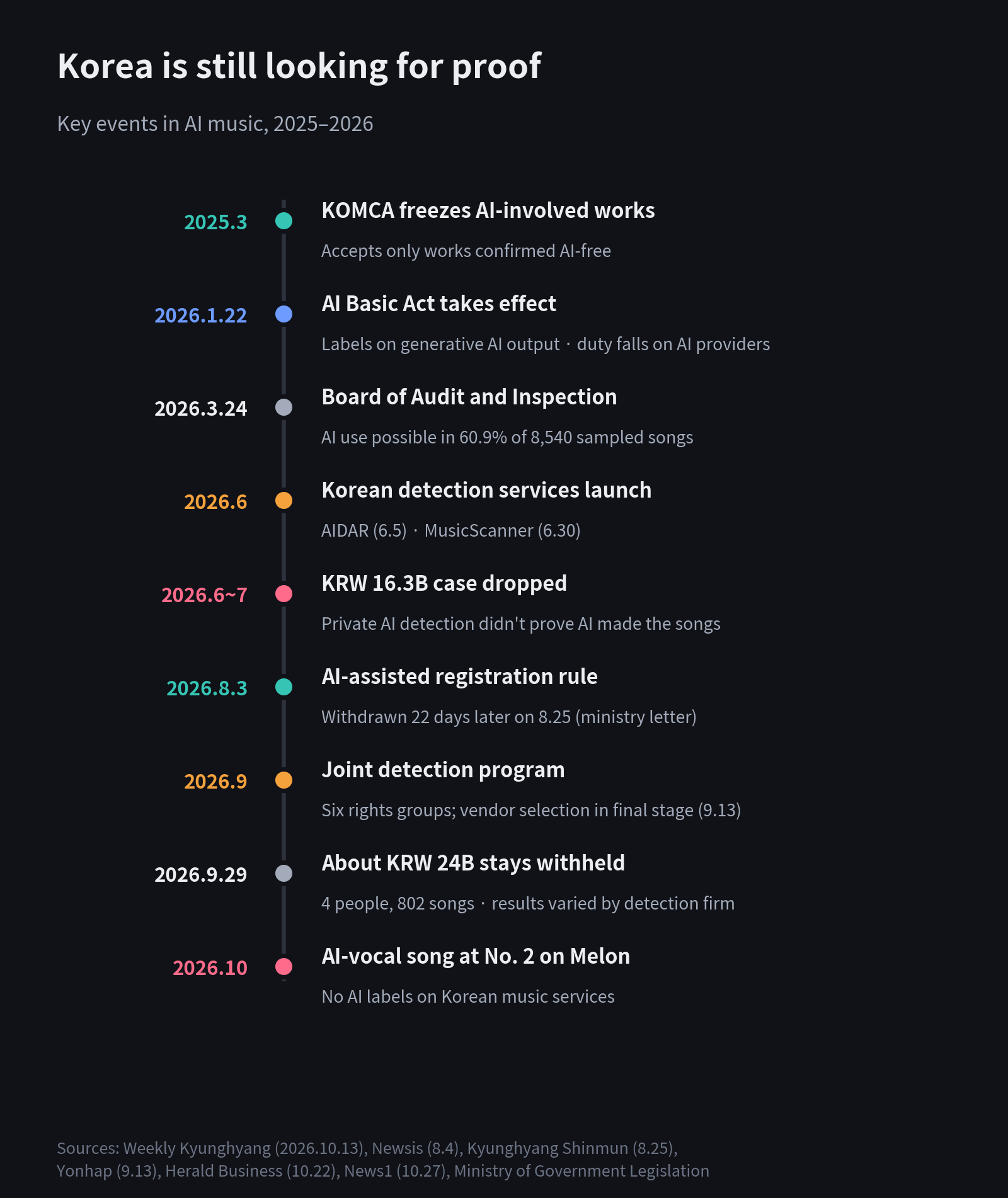
Since March 2025, KOMCA has accepted only works whose creators confirm that no AI was used. On August 3, 2026, it introduced a new standard that would accept AI-assisted works under conditions, but withdrew it 22 days later after the Ministry of Culture, Sports and Tourism called for broader public discussion.
Detection results also failed to count as evidence. A case involving 16.3 billion won in royalties, paid over about a year and a half to four people suspected of mass-producing songs with AI, ended this summer without referral to prosecutors. Police looked at results from private AI detection services but concluded it had not been proven that AI made the songs. When KOMCA sent 791 songs suspected of royalty abuse through YouTube Shorts to overseas analysis firms, some showed signs of AI generation, but the results differed from firm to firm and nothing could be confirmed. At its September board meeting, KOMCA decided to keep withholding about 24 billion won tied to four rights holders and 802 songs. Six Korean rights organizations, including KOMCA, are trying to adopt an AI detection program together, and in mid-September it was reported that vendor selection was in its final stage.
Meanwhile, Meomureu's "꿈꾸던 어른이 되었나요?" ("Have I Become the Adult I Dreamed Of?"), a song with an AI-generated vocal, climbed to No. 2 on the Melon Top 100 in October. Korean music services still show no AI labels. Korea's AI Basic Act, in force since January 22, 2026, requires generative AI output to be labeled, but that duty falls on AI providers. It does not apply directly to the people who make songs or to music platforms.
What these services tell us
Factory numbers
On busy days, uploads pass the halfway mark, while streams stay at 1 to 3%, and a large part of those streams is fraud. The generation side moves faster still. An investor deck reported in November 2025 said Suno makes about 7 million songs a day. Mass production aimed at monetization is already happening. Music that targets only the royalty system, with no one listening, is closer to financial fraud than to creative work.
The tool makers grow while the road to selling tracks narrows
The companies that make AI music tools are growing fast. In February 2026, Suno said it had 2 million paying subscribers and annualized revenue of $300 million. In June it raised money at a valuation of $5.4 billion. It settled with Warner Music Group in November 2025 and became its partner, on the condition that it switch to licensed models in 2026 and let only paid accounts download songs. On the other hand, it lost the first-instance ruling in the lawsuit brought by GEMA, Germany's music copyright society, in July 2026 (not yet final), and Universal and Sony filed a second lawsuit in September.
The road for people who want to make tracks and earn royalties from them is narrowing. Deezer pays nothing for AI streams it judges fraudulent, and TIDAL pays no royalties on fully AI tracks. Spotify pulls them from recommendations, and Bandcamp will not take them at all. In Korea, royalties on the songs under suspicion are being withheld. A business model built on churning out AI tracks for royalties looks harder and harder to sustain. The company selling the tool and the person selling the songs made with it are in very different positions. This is my own judgment, based on the trend so far.
Checking is free; the money is in royalty settlement
Detection is becoming free. Streaming companies, generative AI companies and Google have all released consumer checks at no cost. The money changes hands on the settlement side: copyright societies, charts and distributors. That is why Deezer sells its detection tool to businesses, and why Korean rights organizations want to adopt a detection program together. There are subscription detection services for individuals, but how long they can hold up among free competitors remains to be seen. My guess is that detection services will lead with free checks and build features on top, such as section-by-section analysis, reports and links to royalty settlement.
The tug-of-war between those who detect and those who evade, and how to think about all of this, is the subject of Part 4.
The DeMetal AI series
- Part 1 · Why someone who worked on detecting AI music set out to remove its metallic sound
- Part 2 · Version 1.0 in a day, and 1.1 the next day
- Part 3 · Tools that clean AI music and services that detect it (you are here)
- Part 4 · A new instrument, or a factory?
- Part 5 · A crackle, changed chords and a different pitch only in FL Studio
Sources
- de-artifact product page (Intrect)
- Comparison test on reducing Suno artifacts (hiropon blog, Japanese, 2026-06-11)
- Deezer: fully AI-generated tracks pass 50% of daily uploads (Deezer Newsroom, 2026-07-21)
- Spotify's AI protection policies (Spotify Newsroom, 2025-09-25)
- Spotify on removing AI spam from recommendations (Spotify Newsroom, 2026-10-20)
- Michael Smith sentenced to 18 months (Music Ally, 2026-10-07)
- YouTube Music introduces AI labels (YouTube Blog, 2026-10-14)
- Bandcamp's ban on AI-generated music (Bandcamp, 2026-01-13)
- Suno Credentials checker (Suno)
- KOMCA keeps withholding about 24 billion won over suspected Shorts royalty abuse (Herald Business, Korean, 2026-10-22)
- Meomureu's song at No. 2 on Melon with no AI label (News1, Korean, 2026-10-27)
- KOMCA withdraws its AI-assisted registration standard (Kyunghyang Shinmun, Korean, 2026-08-25)
- Korea's AI Basic Act, Article 31 (Korea Law Information Center, Korean)
Images: the DeMetal AI screens and measurement charts are my own; labels inside the plugin screens and some measurement charts are in Korean. The diagrams and explanatory charts were drawn from synthetic signals and public data.
Words by HongTon_E (TAPE Agency)
#DeMetalAI #AIMusic #Suno #FLStudio #AudioPlugin #AIMusicDetection #MusicProduction #MagTAPE #TAPEAgency
Comments
Loading comments…