
The technology that detects AI music and the technology that erases its traces grow together, each chasing the other. Part 3 looked at tools that clean up AI music, services that detect it, and the numbers around them. This part covers the arms race between detection and evasion, what a detection patent means, and how I thought, at the end of October, about making money from music made with AI.
A tug-of-war between detection and evasion
In "The AI Music Arms Race," a 2025 paper by researchers at KTH Royal Institute of Technology in Sweden, one commercial detection service misjudged 4.7% of human-made tracks as AI. When the audio was saved again at a slightly lower sample rate (22.05 kHz), it missed all five Suno tracks in a small 15-track test. Deezer's own researchers reported that performance drops sharply when you shift the pitch slightly, add noise or compress the audio again. In a benchmark released in October 2026 (MuseBench), one detection model mistook 93.6% of AI tracks for human ones once the pitch and speed were changed.
On the detection side, retraining on processed AI audio brings accuracy back, and in 2026 a detection method appeared that holds up against changes in speed and pitch. When one side pulls ahead, the other catches up. And as Korea shows, when results differ from one detection firm to the next, those results do not count as evidence.
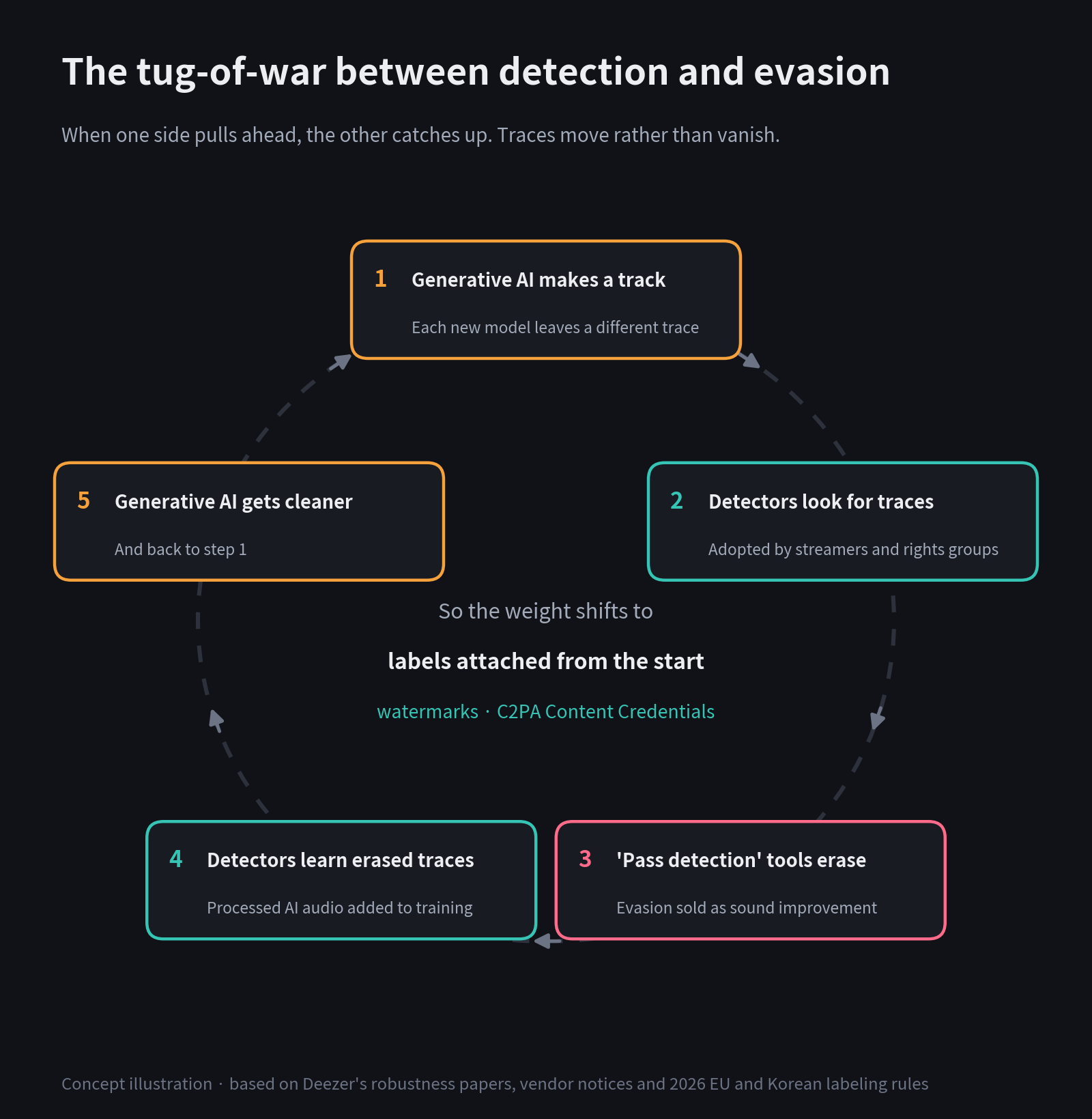
So the weight is shifting to labels attached from the start. Suno has begun attaching digital certificates to downloaded tracks, and in August it announced that it would put watermarks into the audio itself. Since August 2, 2026, Article 50 of the EU AI Act has required machine-readable marking of sound generated by AI, with services already on the market given until December 2. Korea's AI Basic Act points the same way. But as we saw, a certificate falls off when the file is saved again. Labeling and detection cannot replace each other; they have to work together.
So what did the patent mean?
When TEAMSPOT filed its detection patent in the summer of 2025, we had to start by explaining why detection was needed at all. A year later, copyright societies want to adopt a detection program together and a streaming company is selling its detection tool. I think raising the problem early meant something. But detection technology cannot stay inside a frame built once. Each time generative models change, the shape of their traces changes too. Whether a subscription service or meaningful revenue can be built on this patent is not yet clear.
A new instrument, or a factory?
How should we see making money with AI-made music? I hold two pictures at once.
In one picture, AI is a new instrument. Drum machines, samplers and Auto-Tune were all accused of ruining music when they first appeared. I, too, remade my own songs with AI this time and refined the results by hand. In July 2026, IFPI and other music organizations proposed labeling "AI-generated" and "AI-assisted" music separately, a way of recognizing music that people lead and AI helps with. Abroad, an AI singer, Xania Monet, was reported in September 2025 to have signed a record deal worth about $3 million, and a country song sung by AI reached No. 1 on Billboard's Country Digital Song Sales chart in November 2025. When a song with an AI vocal reaches No. 2 on Melon, it suggests listeners sometimes respond to the song itself rather than to how it was made.
In the other picture, AI is a factory. A single streaming service takes in 90,000 such tracks a day, machines inflate play counts with no one listening, and other people's voices get imitated. In a survey by Deezer and Ipsos, 97% of respondents could not tell AI tracks from human ones in a blind test. If the ear cannot tell the difference, there is little left to draw the line with except honest disclosure.
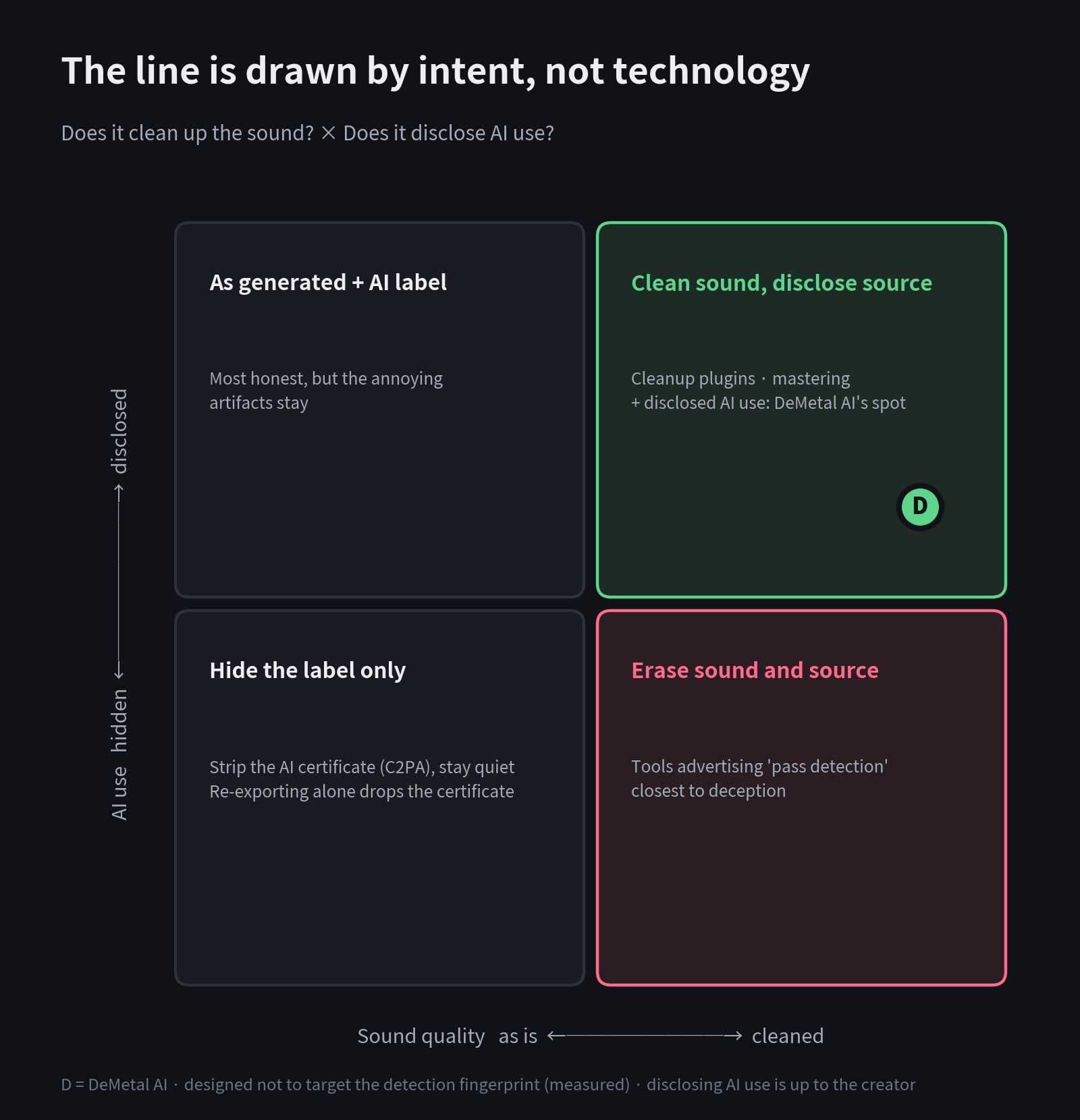
DeMetal AI stands somewhere between those two pictures. I built it as a tool for cleaning up sound quality and designed it not to target the detection fingerprint. Suno's terms also forbid removing watermarks or metadata to hide where a track came from or which plan it was made on. Still, it is uncomfortable to admit that an AI track with less metallic sound is harder to tell apart from a human one by ear. Even without dodging machine detection, it can be used to fool listeners. The line is drawn less by the technology than by what the person using it is trying to hide.
Where I stand now
On October 30, Suno released a beta tool for making songs inside ChatGPT, Claude and Gemini. We have reached the point where one chat window can make a song, find its traces, and even build a tool to remove its metallic sound.
The second version of DeMetal AI (1.1) is installed in my FL Studio. I am testing it in different ways, switching presets for each song and listening to what it removes. I have not run a wider listening test yet, and I have no plan to share it yet. To distribute it, I would have to publish the source under its open-source license (AGPL) and get Apple developer signing and notarization.
I still do not know whether this is a tool that creates new value or makeup that hides fraud. But the cleaner AI-made sound becomes, the heavier the responsibility to say that it was made with AI. Having started on the side that detects and come all the way to the side that removes, I think it is time to ask about the attitude of the people using the technology before asking about the technology itself.
What happened in the week after I wrote this, using 1.1 on real songs, is in the final part, Part 5.
DeMetal AI and AI music in five questions
Where can I get DeMetal AI?
You can't right now. It is a Mac plugin I made for my own experiments. Before it could be distributed, the source would have to be published under its open-source license (AGPL), and the plugin would need Apple developer signing and notarization.
Can this plugin help a track get past AI detection?
No. It was designed not to target the fingerprint that detectors use, and in eight real tracks none showed a weaker detection signal after processing. Note, though, that a file exported again from FL Studio no longer carries the AI certificate (C2PA) the original had, so you need to say yourself that the track was made with AI when you release it.
Why do Suno tracks sound metallic?
There is more than one cause. Research shows that regular artifacts can be left behind when a generative model expands its compressed blueprint into sound. The high end also often comes out far too bright. Compression noise from the download format (MP3) can add to it as well.
Can I register an AI-made song with KOMCA?
As of October 2026, KOMCA accepts only works whose creators confirm that no AI was used. The registration standard for AI-assisted works introduced in August was withdrawn after 22 days. Copyright protection also covers only the parts created by people.
Will my AI track be labeled on streaming services?
It depends on the platform. Deezer tags AI tracks, and YouTube Music has labeled tracks made primarily with AI since October 14, 2026. Spotify uses AI credits and badges. Korean services such as Melon do not show AI labels yet.
The DeMetal AI series
- Part 1 · Why someone who worked on detecting AI music set out to remove its metallic sound
- Part 2 · Version 1.0 in a day, and 1.1 the next day
- Part 3 · Tools that clean AI music and services that detect it
- Part 4 · A new instrument, or a factory? (you are here)
- Part 5 · A crackle, changed chords and a different pitch only in FL Studio
Sources
- The AI Music Arms Race: On the Detection of AI-Generated Music (Cros Vila et al., TISMIR 2025)
- MuseBench detector comparison (arXiv, 2026-10)
- Improved Robustness in AI-Generated Music Detection (to be presented at ISMIR 2026)
- Detecting music deepfakes is easy but actually hard (Afchar et al., 2024)
- Regulation (EU) 2026/1744 amending the AI Act (EUR-Lex)
- Korea's AI Basic Act, Article 31 (Korea Law Information Center, Korean)
- Suno Terms of Service (effective 2026-09-03)
- Proposed labels for AI-generated and AI-assisted music (IFPI, 2026-07-10)
- Deezer: fully AI-generated tracks pass 50% of daily uploads (Deezer Newsroom, 2026-07-21)
- Meomureu's song at No. 2 on Melon with no AI label (News1, Korean, 2026-10-27)
- YouTube Music introduces AI labels (YouTube Blog, 2026-10-14)
- Spotify's AI protection policies (Spotify Newsroom, 2025-09-25)
- KOMCA withdraws its AI-assisted registration standard (Kyunghyang Shinmun, Korean, 2026-08-25)
Images: the DeMetal AI screens and measurement charts are my own; labels inside the plugin screens and some measurement charts are in Korean. The diagrams and explanatory charts were drawn from synthetic signals and public data.
Words by HongTon_E (TAPE Agency)
#DeMetalAI #AIMusic #Suno #FLStudio #AudioPlugin #AIMusicDetection #MusicProduction #MagTAPE #TAPEAgency
Comments
Loading comments…