
In the summer of 2025, TEAMSPOT (TAPE Agency), the company I work with, filed a patent for telling AI-made music apart from human-made music. Fifteen months later, in October 2026, I went the other way and built an FL Studio plugin that removes the metallic sound from AI music. It is called DeMetal AI. It splits a track into six bands, then finds and reduces the metallic ring, the high-end fizz and the noise floor that come with songs made by generative AI such as Suno. Claude and I built the first version in a single day, October 29. The second version (1.1) followed the next day, and I am now testing it on song after song in my own FL Studio.
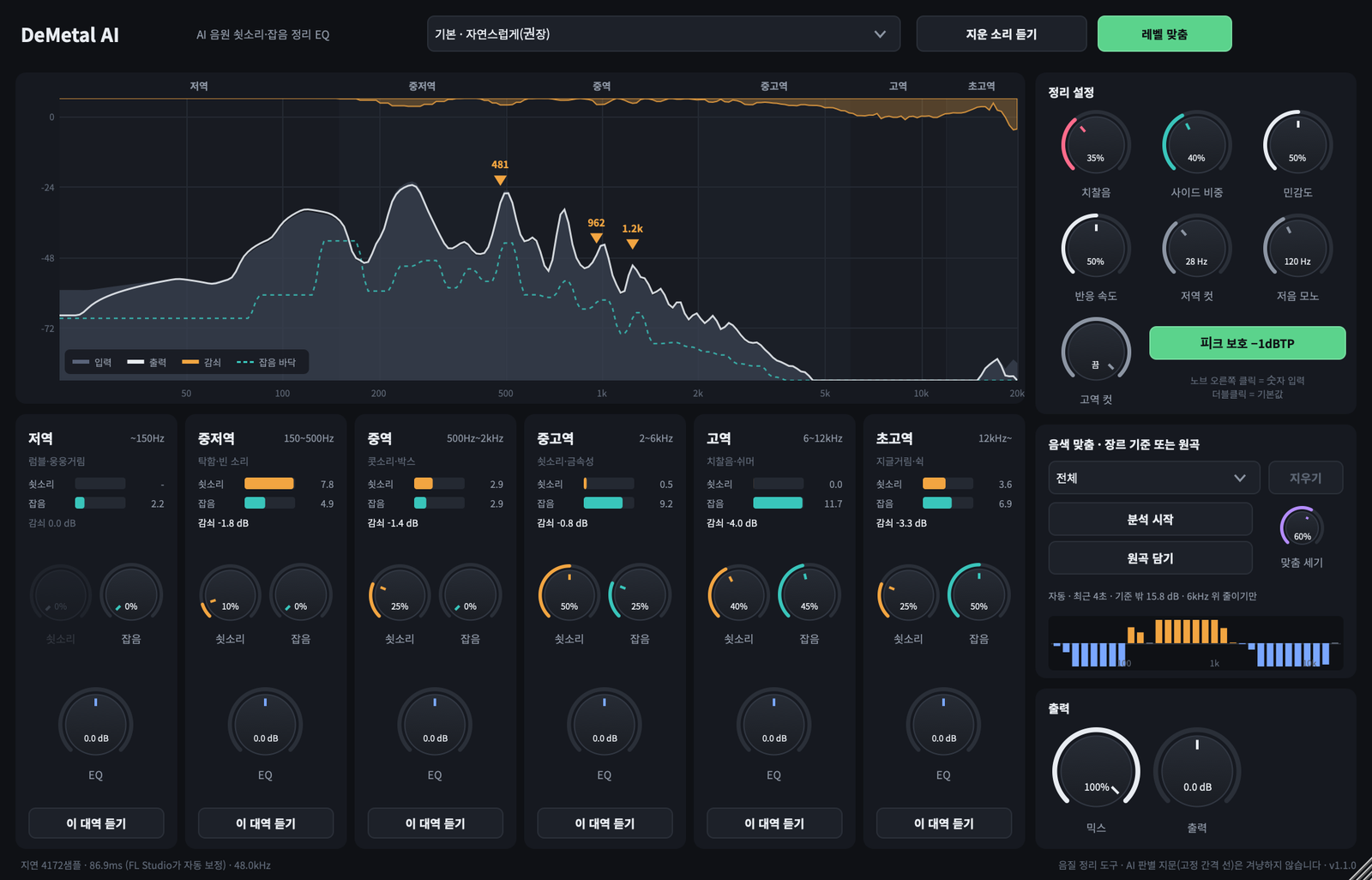
This is a five-part series. Part 1 covers why I built it, Part 2 the 1.0 I made in a day and the 1.1 that followed, Part 3 similar tools and services, Part 4 the questions the project raised, and Part 5 the problems I heard after a week of use. I have kept the technical parts as plain as I could.
It started on the detection side
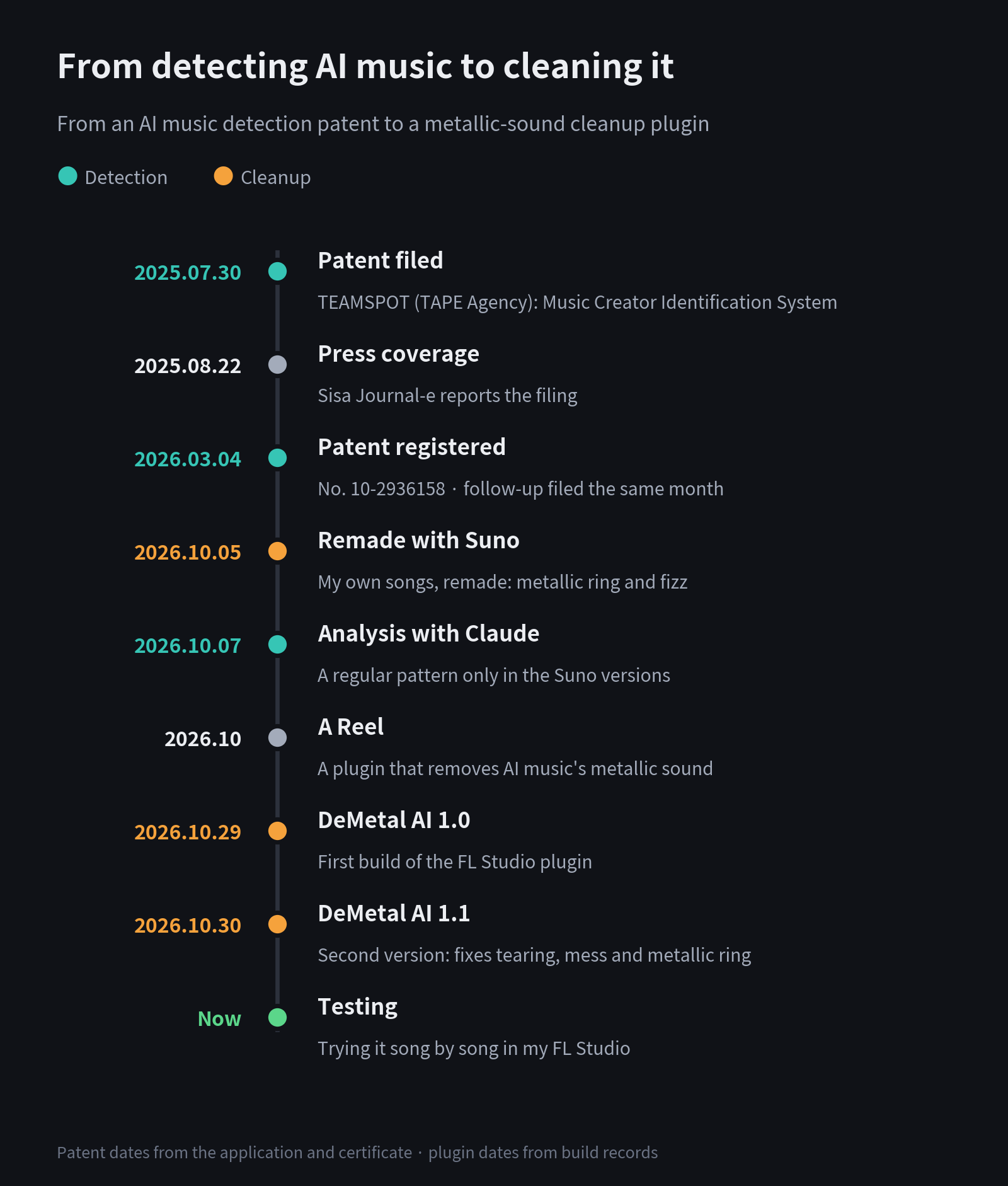
On July 30, 2025, TEAMSPOT filed a patent application in Korea for a "Music Creator Identification System" (application no. 10-2025-0104162). The system looks at a track along five lines (time, frequency, psychoacoustics, song structure and machine-learning features) and answers with a probability: did a person make this, or did AI? After priority examination, it was registered on March 4, 2026 as Korean Patent No. 10-2936158. In the same month we filed a follow-up application focused on audio signatures.
Sisa Journal-e reported the filing on August 22, 2025. Our concern back then was simple. YouTube, Threads and Instagram were full of posts about making money with AI-generated tracks. The Korea Music Copyright Association (KOMCA) was asking for written confirmation that no AI had been used, but there was no technical way to check whether that was true. In the interview, we described these tracks as pouring out "like mining bitcoin."
I remade my own songs with Suno
A little over a year later, on October 5, 2026, I took a few songs I had made and remade them with Suno. One was "Ulssu," a track from 2024; another was a breakbeat track from 2025. The first few seconds sounded convincing. Then something started to catch my ear. A metallic ring cut through the hi-hats and the high notes. The top end fizzed like sand, and a thin layer of hiss sat in the gaps even when the music paused. It was clearly my song, yet it felt strange, like someone doing an impression of it.
I was not the only one hearing it. Suno's user communities keep posting about "shimmer," metallic tones and high-frequency hiss. After v6 arrived in September 2026, posts appeared saying the sound gets muddier toward the end of a song. Suno itself said in May 2025, when it released v4.5, that it had reduced shimmer and audio degradation. The company knows about the problem and has been working on it. It has not finished.
Then I asked Claude to check them
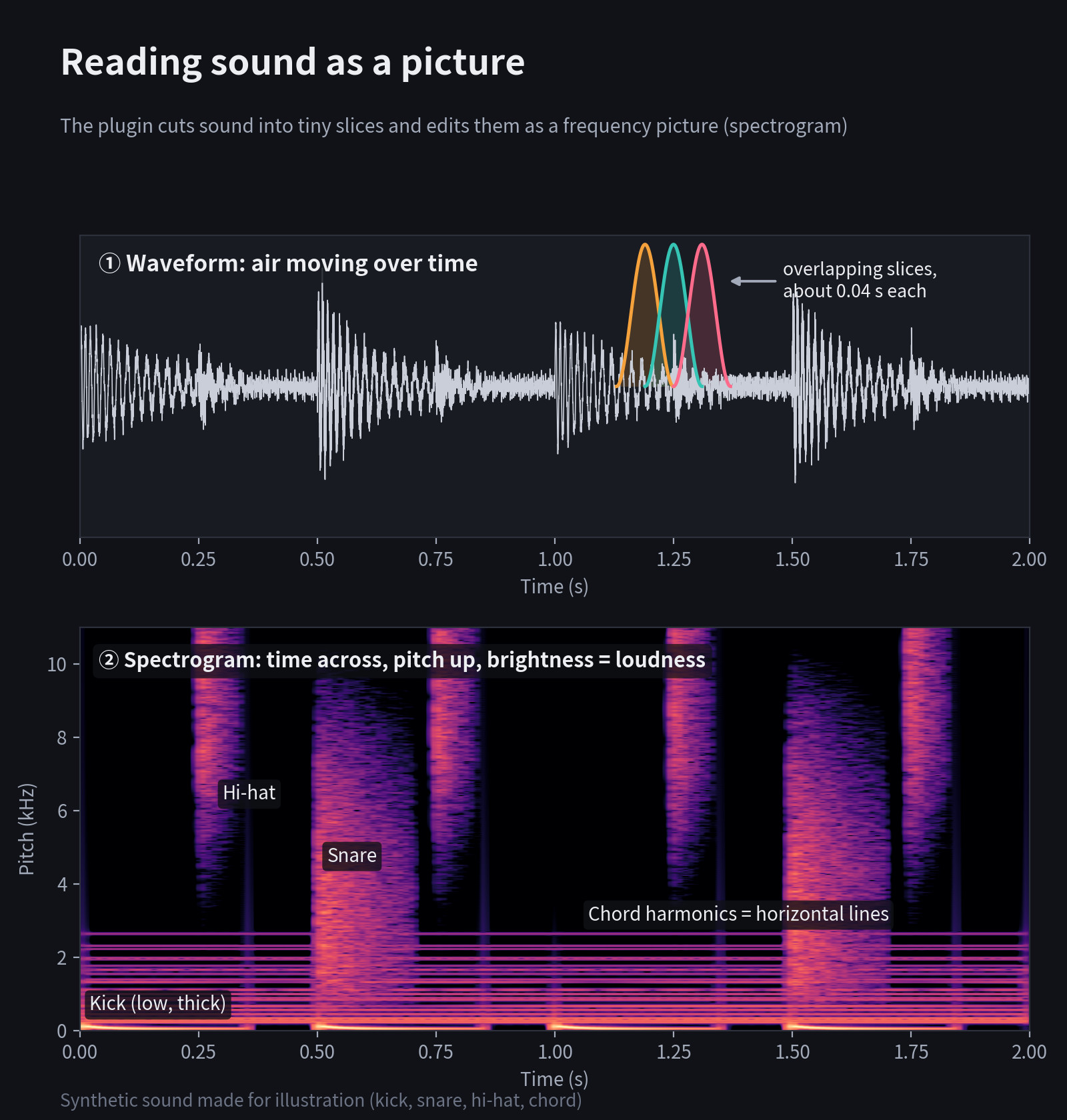
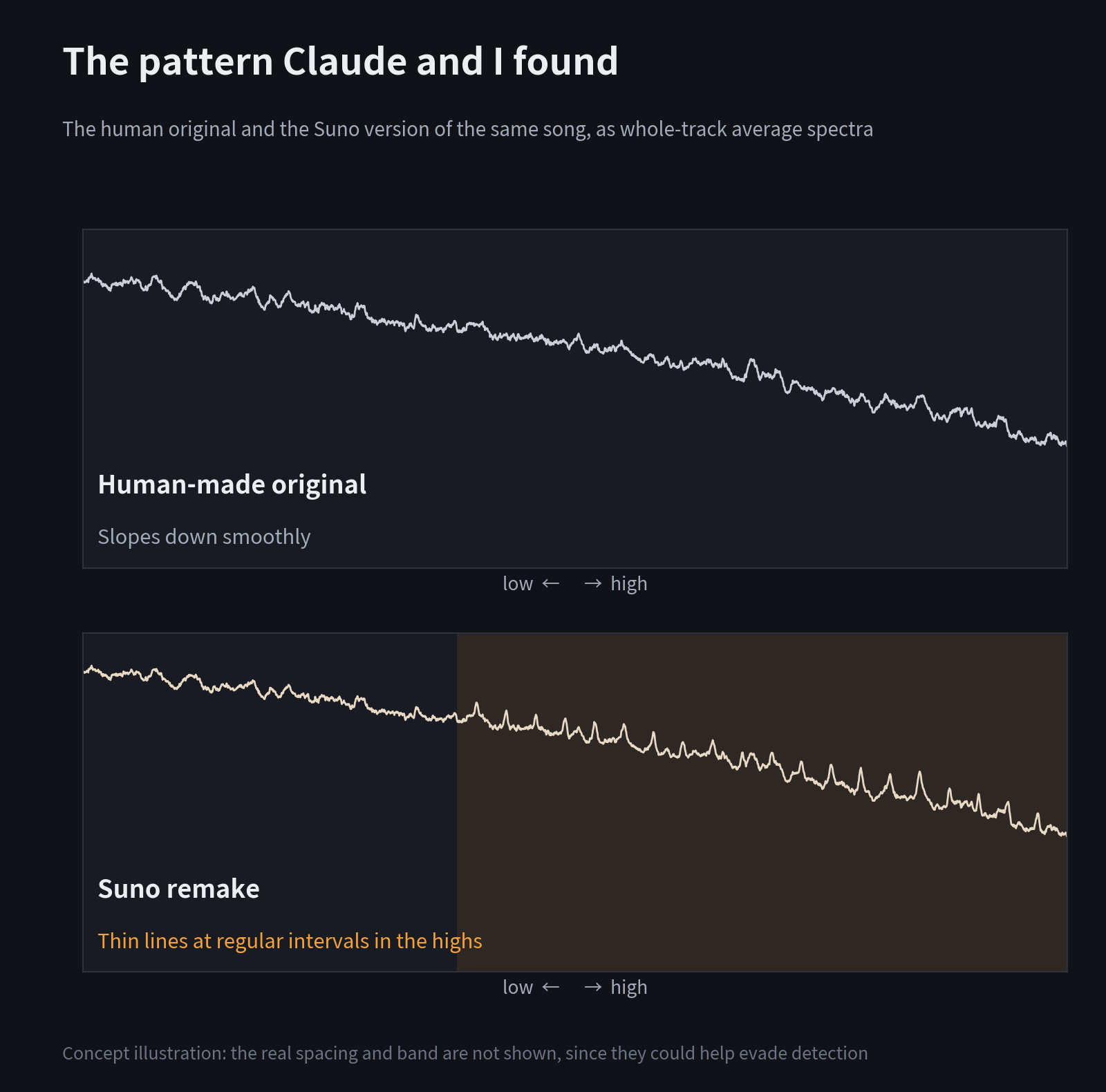
On October 7, I asked Claude to analyze the tracks. I gave it the Suno remakes and, for comparison, 15 human-made tracks including my originals. Claude cut each track into very small slices, turned each slice into a frequency picture and averaged them. Before going further, here is how to read a frequency picture.
Only the sound Suno had made showed thin lines standing at regular intervals in the high range. In the 15 human-made tracks, those lines were hardly visible. In a mix where I had laid my original parts over the Suno version, the lines were still there. Cutting the Suno version into sections a few seconds long did not help either: there was no stretch without them. When I lined up my original and the Suno version bar by bar, even the order did not match. Suno had not polished my original so much as regenerated the whole sound.
One more thing stood out. Some of the Suno files I downloaded around then carried a digital certificate inside the file stating that the audio was AI-generated (C2PA Content Credentials). Others did not. A tag like that falls off as soon as you export the file again from another program. A pattern carved into the sound itself does not disappear so easily.
Researchers explain where these lines come from. A generative model does not produce sound directly. It first builds a small compressed "blueprint" of the whole song, then expands that blueprint again and again, two times, four times, until it becomes audio made of tens of thousands of points per second. Because the expansion is so regular, thin lines at regular intervals are left in the sound. Researchers at Dolby described this in 2021 as upsampling artifacts (Pons et al., ICASSP 2021). In 2025, researchers at the French streaming company Deezer reported that this periodic pattern alone can identify AI music with more than 99% accuracy (Afchar et al., ISMIR 2025).
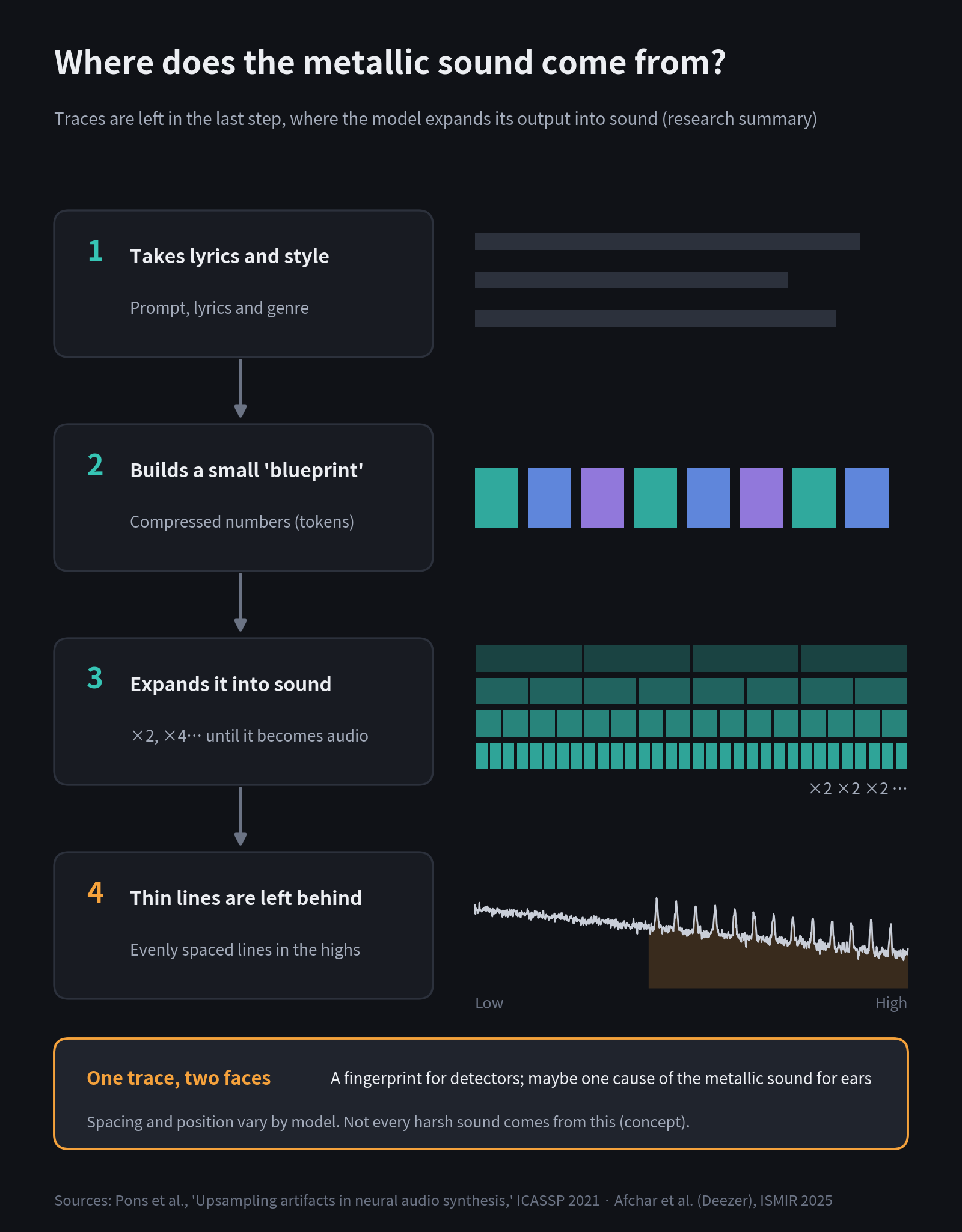
The same 2021 paper noted that these artifacts can show up as noise with a pitch, a tonal artifact. That does not mean every harsh sound we hear comes from these lines. What the detection papers proved is their value as a fingerprint, nothing more. That the two may share part of their roots is only my guess. I am deliberately leaving out the exact spacing and position of the pattern. Those numbers would be most useful to anyone trying to dodge detection.
One Reel, and the idea of working in reverse
Around then I watched a Reel about someone who had built a plugin that removes the metallic sound from AI music. When I looked, I found several tools like it. A company called Intrect began promoting "de-artifact," a plugin that removes artifacts from AI music, in September 2026. You can switch between the original, the cleaned sound and what was removed, and it currently sells for $149. The product page says it is not a tool for passing AI detection. In the communities, people were also sharing ways to use restoration tools such as Zynaptiq's UNCHIRP, originally made to reduce the chirpy artifacts of low-bitrate MP3s, and iZotope's RX on Suno tracks.
If Claude could find the traces of AI audio, maybe it could also build a tool that works in reverse, reducing only the traces that bother the ear. It was an experiment in turning the questions behind our detection patent the other way around. On October 29, I asked Claude for this: "An installable FL Studio plugin that removes the metallic sound typical of AI music. Use knobs to see each EQ band and control the AI-specific noise and metallic sound found there. A MacBook installer is enough."
I talked and listened; Claude built and tested
We split the roles clearly. I explained what I wanted in plain words and listened to the results. Claude did the research, the design, the code, the tests and even the installer. The plugin is written in C++ with JUCE, a framework widely used for audio plugins, and it comes in the VST3 and AU formats that FL Studio loads. A single installer runs on both Apple silicon and Intel Macs.
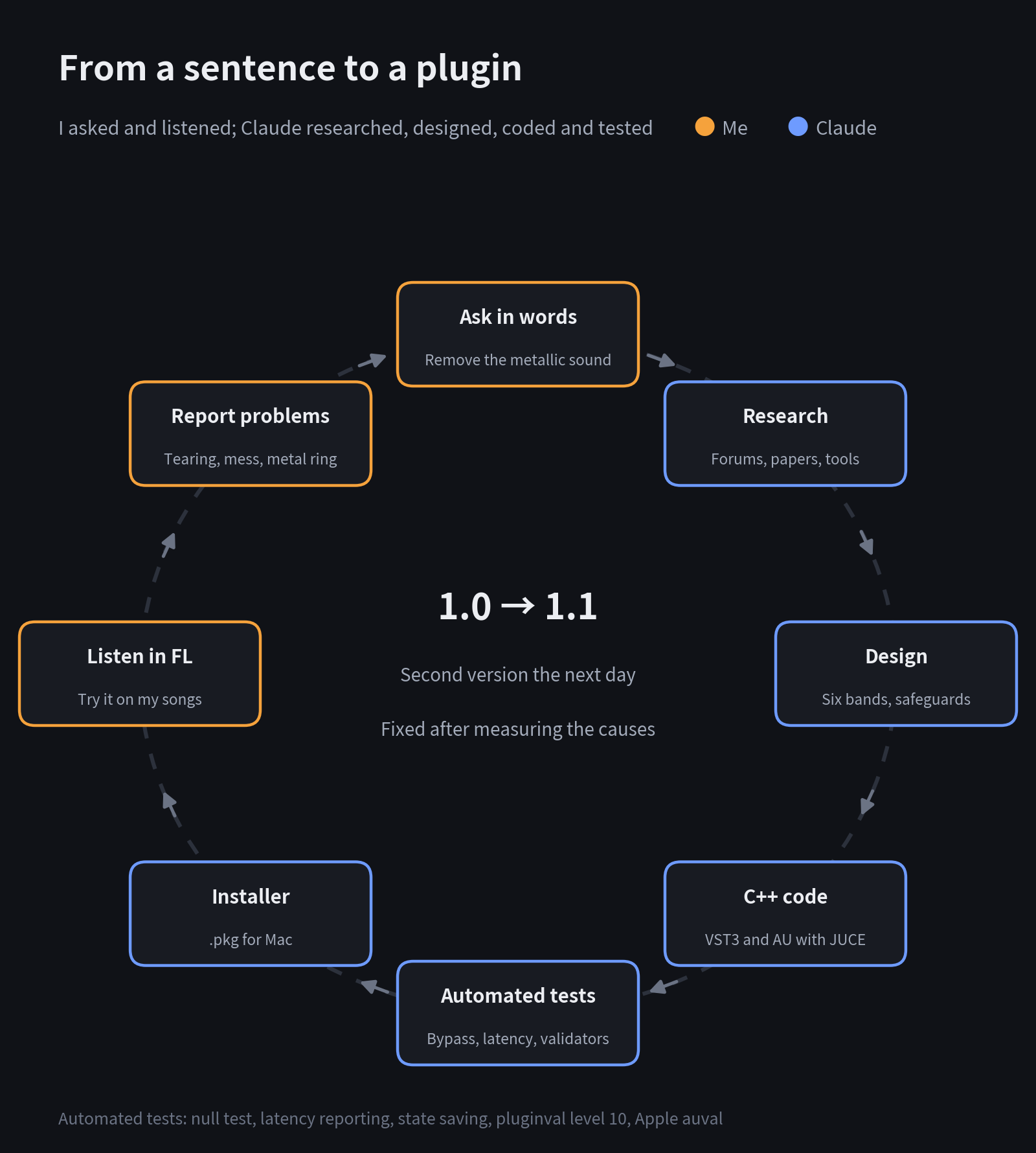
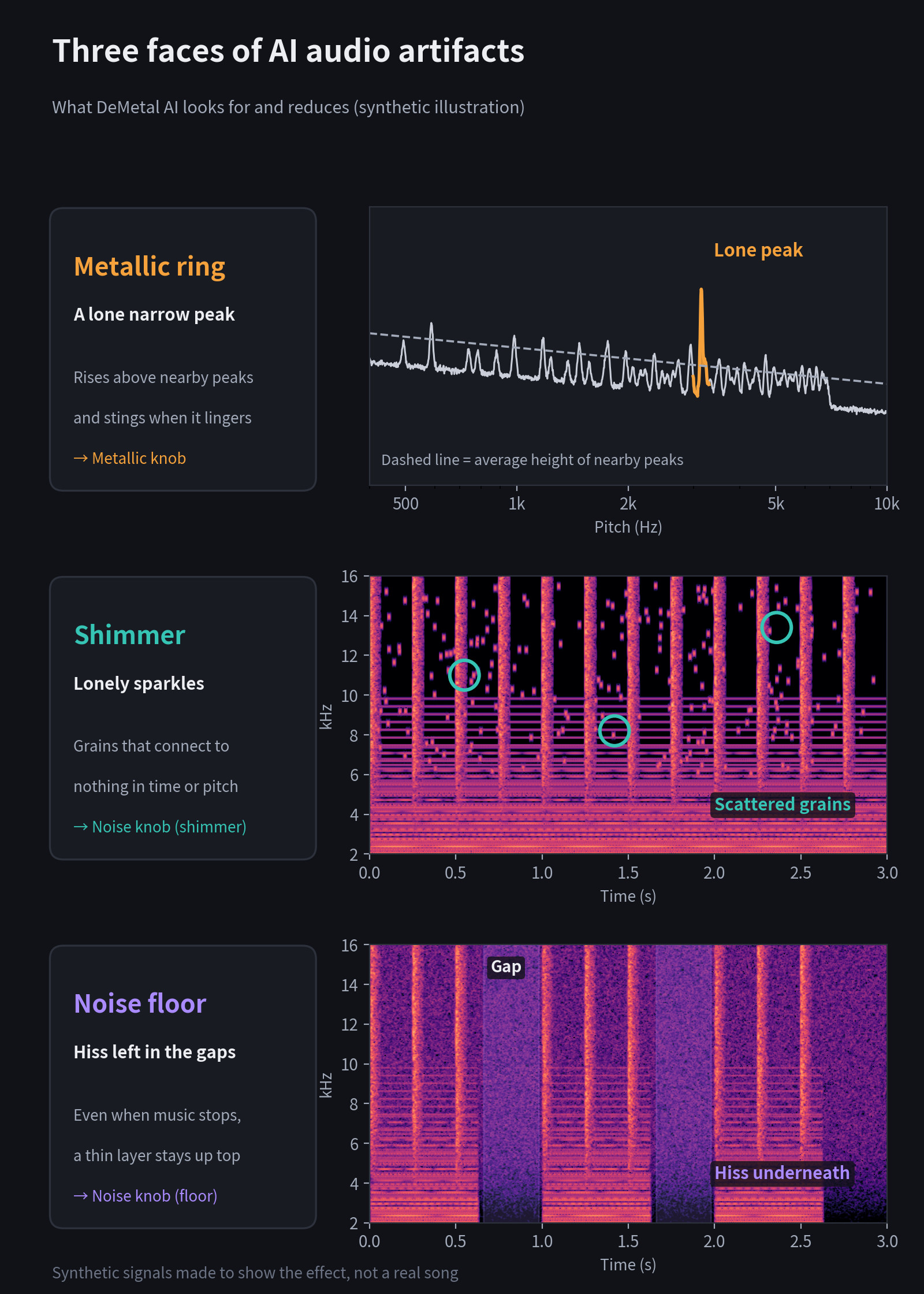
The first thing Claude did was research. It gathered what symptoms people complain about, which tools they use and how, and how researchers explain the causes. That made it obvious that what we lump together as "metallic sound" is really three different things: a narrow peak that rises above its neighbors (resonance), isolated sparkles that connect to nothing in time or frequency (shimmer), and a noise floor that stays even when the music pauses. A comparison posted in June 2026 by a composer in Japan shows this well. A popular resonance suppressor (soothe3) left the fizz in a Suno track almost untouched even at strong settings. UNCHIRP did better, and processing only the sides of the stereo image kept the sense of space best. Shimmer and resonance are different problems.
That is how version 1.0 came out in a single day. How it was built, and what broke the moment I put it on my own songs, is the subject of Part 2.
The DeMetal AI series
- Part 1 · Why someone who worked on detecting AI music set out to remove its metallic sound (you are here)
- Part 2 · Version 1.0 in a day, and 1.1 the next day
- Part 3 · Tools that clean AI music and services that detect it
- Part 4 · A new instrument, or a factory?
- Part 5 · A crackle, changed chords and a different pitch only in FL Studio
Sources
- Sisa Journal-e on TEAMSPOT's AI music detection patent filing (Korean, 2025-08-22)
- KR102936158B1, Music Creator Identification System (Google Patents)
- Suno v4.5 announcement (Suno Blog, 2025-05)
- Suno Credentials checker (Suno)
- A Fourier Explanation of AI-music Artifacts (Afchar et al., ISMIR 2025)
- Upsampling artifacts in neural audio synthesis (Pons et al., ICASSP 2021)
- de-artifact product page (Intrect)
Images: the DeMetal AI screens and measurement charts are my own; labels inside the plugin screens and some measurement charts are in Korean. The diagrams and explanatory charts were drawn from synthetic signals and public data.
Words by HongTon_E (TAPE Agency)
#DeMetalAI #AIMusic #Suno #FLStudio #AudioPlugin #AIMusicDetection #MusicProduction #MagTAPE #TAPEAgency
Comments
Loading comments…