
On November 19, the Hercules DJControl Starlight was selling for ₩159,000 at a Korean retailer. Plug its single USB cable into a laptop and the free Serato DJ Lite software lets you blend two tracks (Hercules, ATOB Shop). It looks like a toy, but the way it locks two beats together and carries one song into the next is the same as the gear in a club booth.
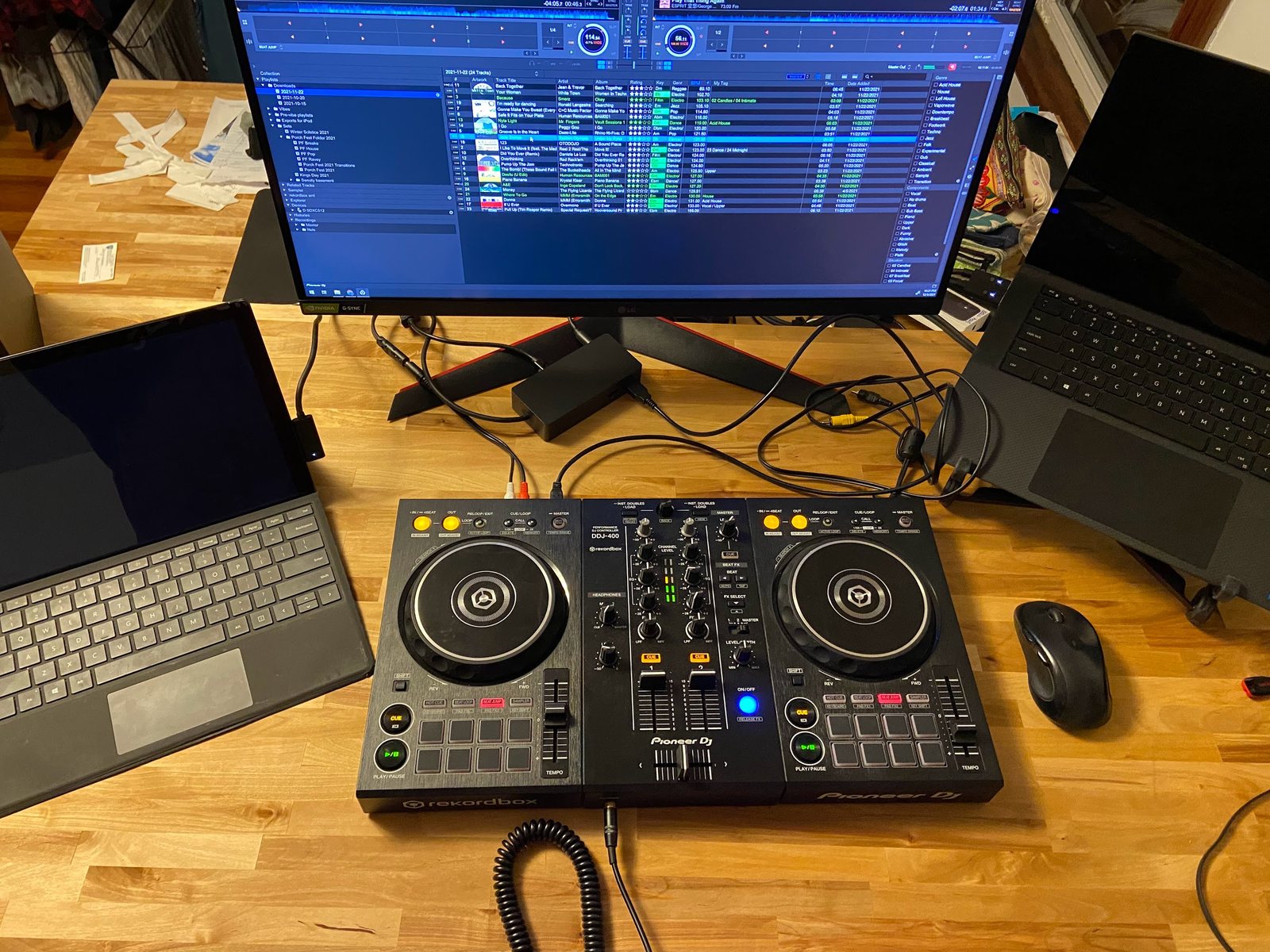
A Pioneer DJ DDJ-400 hooked up to a laptop and monitor, with rekordbox on screen. This is how a controller works: together with DJ software on a computer (photo taken in 2021). Source: Photo by Nelsnelson, CC BY-SA 4.0, Wikimedia Commons 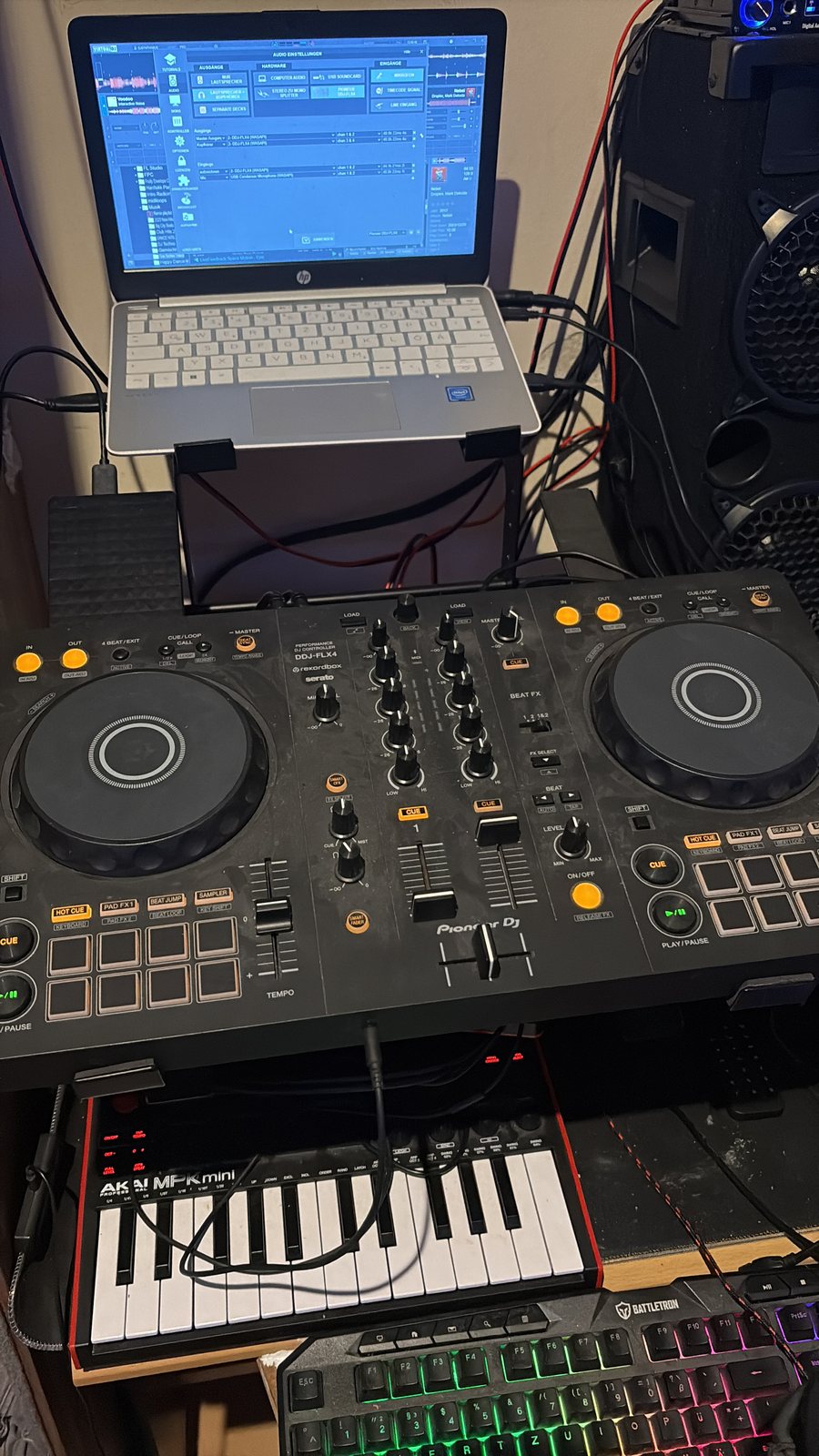
A practice corner set up at home: a DDJ-FLX4 with a laptop above it and a speaker alongside (photo taken in 2025). Source: Photo by Marcel Glanz, CC BY 4.0, Wikimedia Commons
"I just want to mix songs for fun before I get serious. Is it worth buying something toy-like like this?" Plenty of people who want to try DJing ask some version of that. MagTAPE's answer is yes, it's worth a go. You learn with your hands what the jog wheels, faders and cue buttons do, and as a teaching tool that's plenty. But before you buy, count one thing: how many knobs each channel has.
Why you need three knobs
A club mixer gives every channel three EQ knobs. Low covers the kick drum and bassline, mid covers vocals and melody, and high covers hi-hats and cymbals (MusicRadar). You need at least that much separation to decide which part of a track to pull back and which to push. Some mixers go further: the Allen & Heath Xone:92 splits the mid into two for a four-band EQ (Allen & Heath).
Layer two tracks and you'll hear why. When both basslines play at once, the low end turns to mush. So a DJ brings the incoming track in with its low cut, and once the beats line up, swaps the bass between the two. That move, the bass swap, is the most basic EQ mix there is (Native Instruments).
The Starlight doesn't have those three knobs. Each deck gets a single knob that doubles as bass EQ and filter. That's enough to practice cut mixing, where you jump from one track to the next, but not to practice swapping the low end. Spend ₩40,000 more and you get the Hercules Inpulse 200 MK3 (₩199,000) with a three-band EQ and a filter. Just know that its high knob also serves as the gain, or input level, control (Hercules).
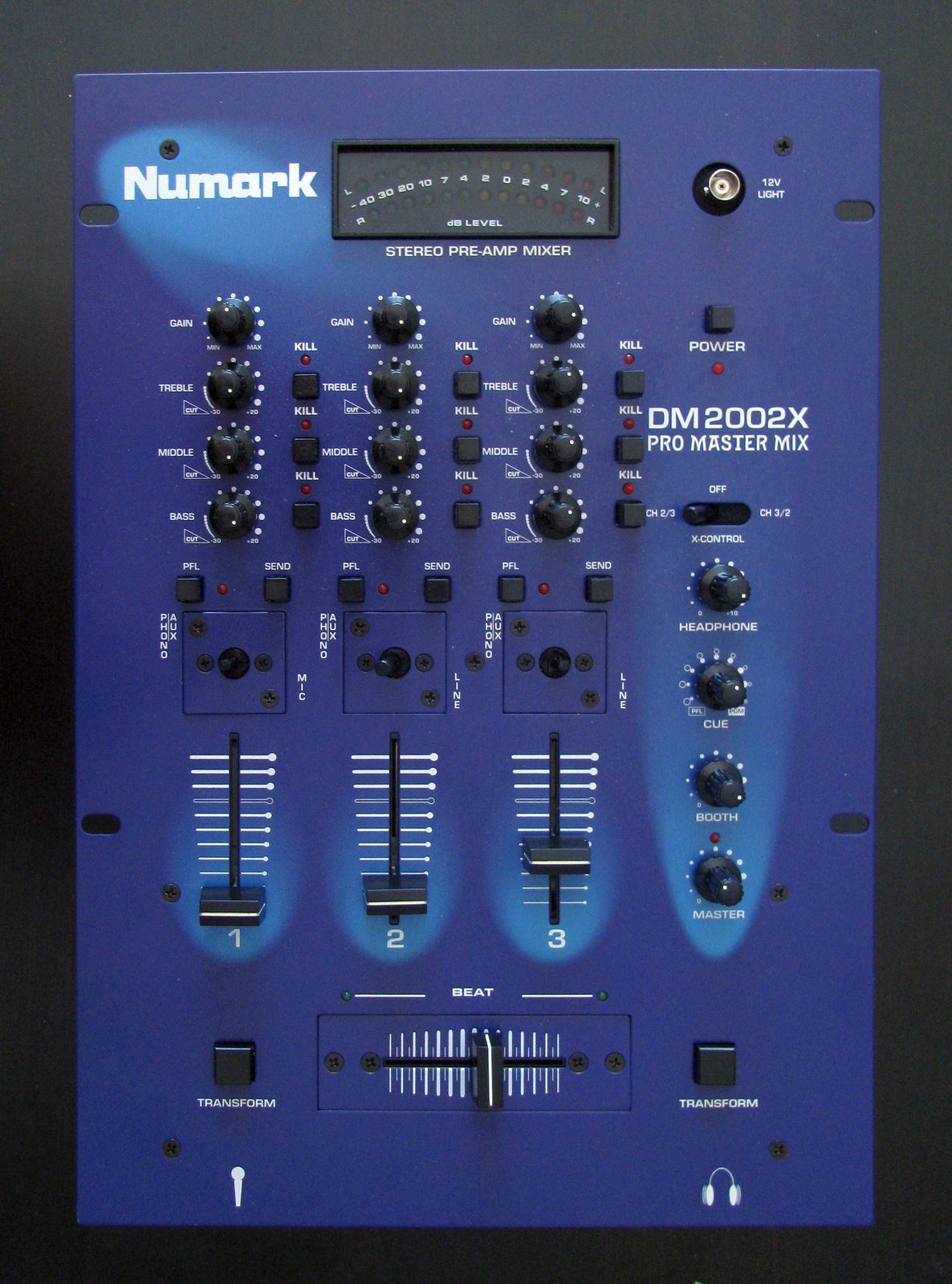
A Numark DM2002X mixer with a three-band EQ on every channel. This model labels high, mid and low as treble, middle and bass (photo taken in 2008). Source: Photo by Jana C., public domain, Wikimedia Commons 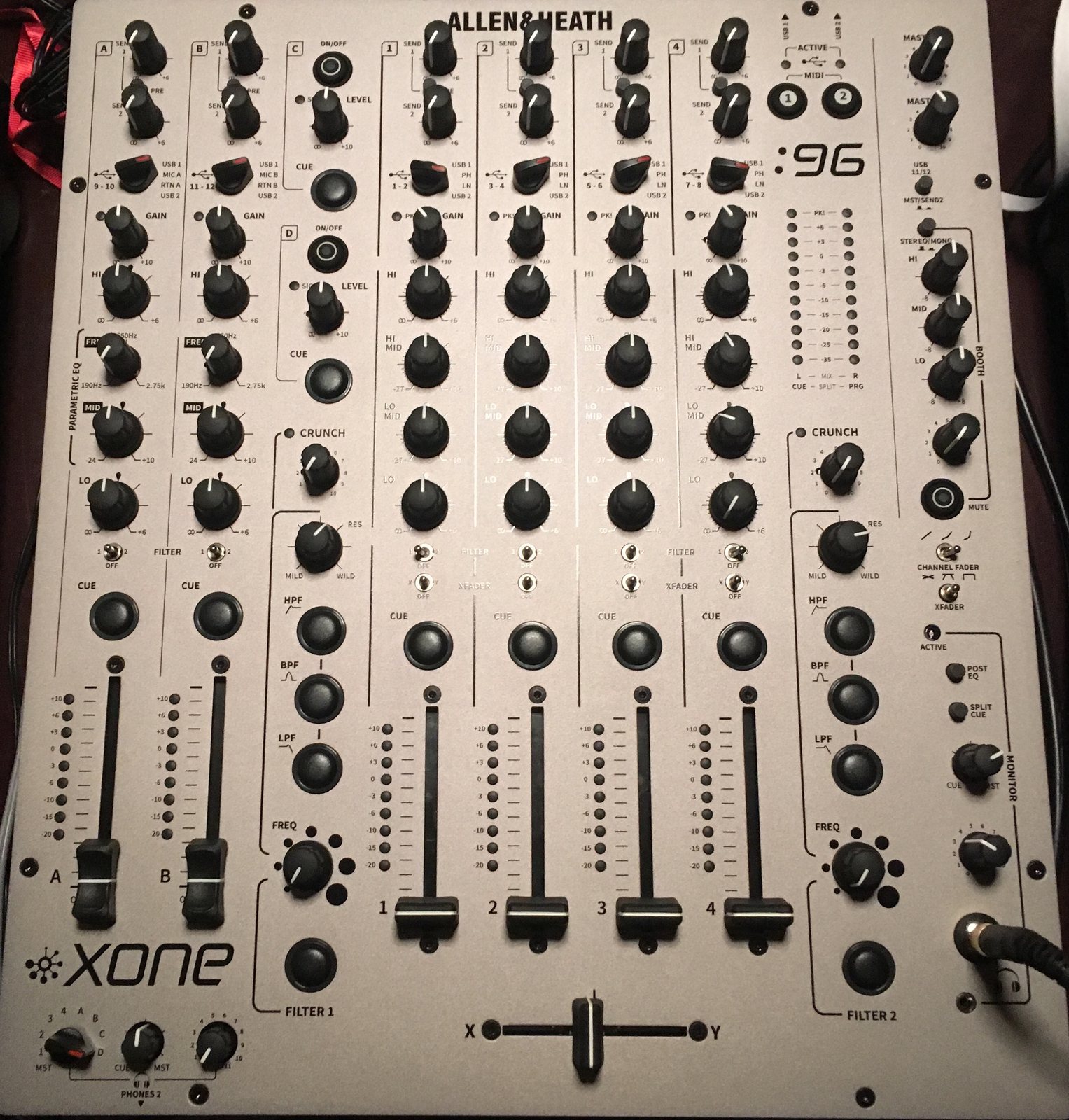
The Allen & Heath Xone:96, whose four-band EQ splits the mid into high mid and low mid (photo taken in 2019). Source: Photo by Vittjas Tief, CC BY-SA 4.0, Wikimedia Commons
A controller makes no sound on its own
A beginner controller doesn't play music by itself. It's a set of hands-on controls for DJ software running on a laptop or phone. AlphaTheta says as much: its DDJ controllers need a computer or mobile device, and the machines that run without a laptop are all-in-one units such as the XDJ-AN (AlphaTheta).
The size is less daunting than it sounds. The DDJ-FLX2, a two-channel starter with a three-band EQ, is 38.3 cm wide and weighs 1.2 kg (AlphaTheta), and the Inpulse 200 MK3 is 32 cm wide and 0.9 kg. These are plastic boxes about the width of a laptop, and the first thing you notice when one arrives is how light it is.
Phone-based models need one extra check. The Hercules DJControl Mix Ultra and the Pioneer DJ DDJ-200 have no audio output of their own, so the sound comes out of your phone. To preview the next track in headphones, you need a separate splitter cable (Hercules, Pioneer DJ). Listening to the next track in your headphones, called cueing, is a DJ basic, so check for a dedicated headphone jack first.
rekordbox or Serato?
After the hardware comes the software. Serato DJ Lite is free and works with more than 50 controllers, but it can't record (Serato). The step up, Serato DJ Pro, costs $299 outright or $11.99 a month, though you won't need to buy it if your controller unlocks Pro (Serato). rekordbox runs from a free plan to paid plans of $12 to $36 a month, and connecting a "Hardware Unlock" device lets you use its controller performance mode even on the free plan (rekordbox plans, rekordbox support).
The two programs come from different places. Serato took root among scratch DJs who handled digital files on turntables, which is why it's common in hip-hop, while rekordbox began as a tool for preparing USB sticks for the CDJs in club booths (We Are Crossfader). If you want to scratch, lean toward Serato; if a club booth is the goal, lean toward rekordbox.
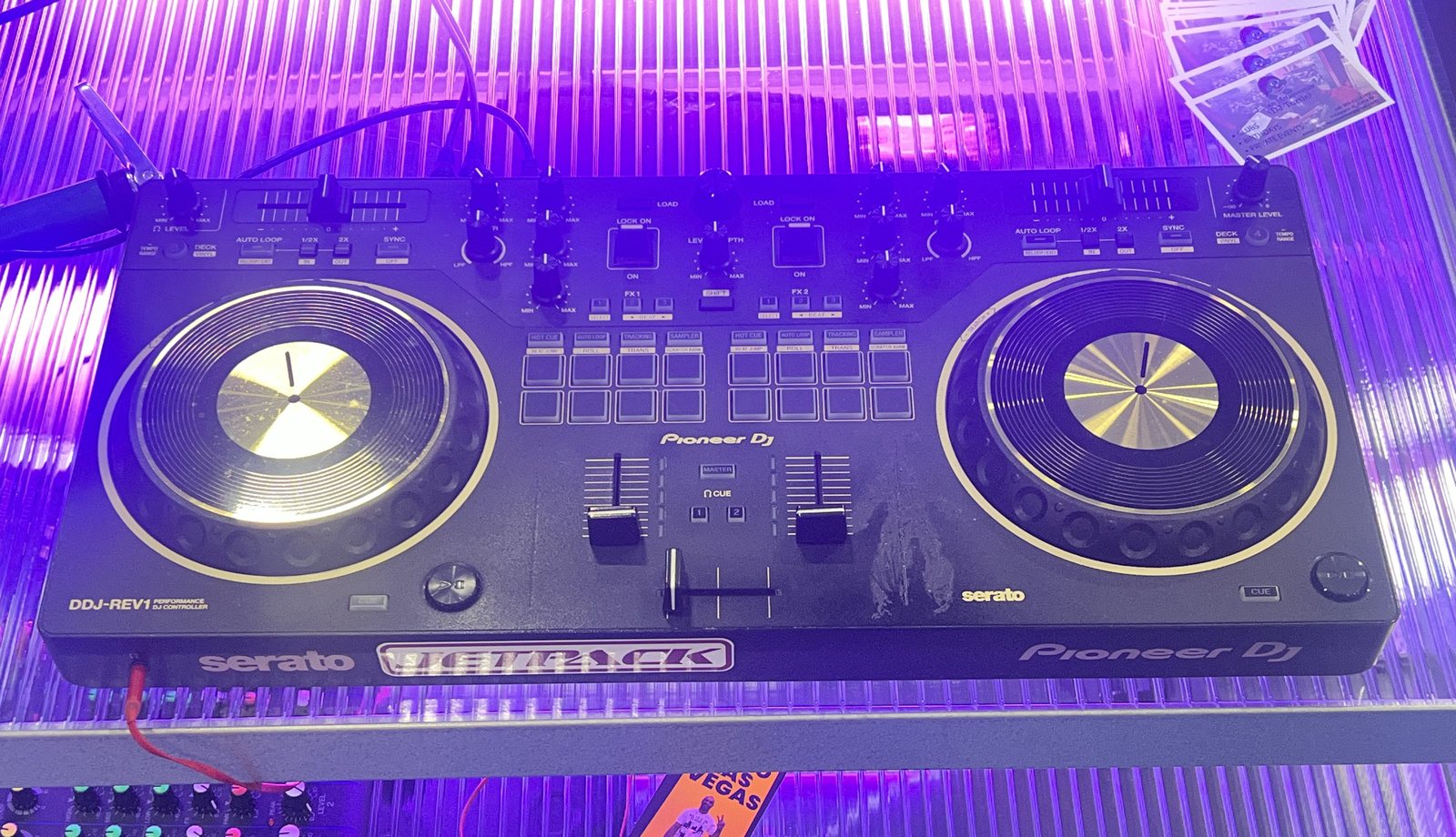
The Serato-branded Pioneer DJ DDJ-REV1, laid out battle-style with the mixer in the middle and a deck on each side like a pair of turntables (photo taken in 2026). Source: Photo by TaurusEmerald, CC BY-SA 4.0, Wikimedia Commons
You're no longer locked into one, though. The DDJ-FLX2 alone supports rekordbox, Serato DJ Lite, djay and Traktor Play. Converters such as Lexicon move your library from one program to another (Lexicon), and in October 2025 several brands launched OneLibrary, a shared library format (rekordbox). Starting with whatever software your controller recommends is fine.
Streaming has arrived too. Since September 2025, Spotify can be played directly in rekordbox, Serato and djay, and Korea is on the list of supported countries (Spotify, supported countries). But it's limited to personal, non-commercial use by Premium subscribers, and it can't be used in clubs, at events or in live streams (Spotify support). Streamed tracks can't be recorded inside the software either (rekordbox streaming guide). It's handy for practice, but tracks you play on stage need to be bought.
First gear by budget
These are Korean retail prices as listed on November 19. They move with every sale.
| Budget | Model (Korean price) | Worth knowing |
|---|---|---|
| Under ₩200,000 | Hercules Starlight (₩159,000) | One bass/filter knob instead of EQ |
| Under ₩200,000 | Hercules Inpulse 200 MK3 (₩199,000) | 3-band, high knob doubles as gain |
| Around ₩300,000 | AlphaTheta DDJ-FLX2 (₩299,000) | 3-band, rekordbox and Serato, phone ready |
| Around ₩300,000 | Hercules Mix Ultra (₩296,000) | 3-band, phone via Bluetooth, battery |
| Around ₩300,000 | Hercules Inpulse 300 MK2 (₩338,000) | 3-band, gain and filter, laptop |
| ₩500,000 to ₩700,000 | Pioneer DJ DDJ-REV1 (₩550,000), DDJ-FLX4 (₩660,000) | Scratch layout, the go-to starter |
| No laptop | Denon DJ Prime Go+ (₩1.87M), AlphaTheta XDJ-AN (₩2.2M) | Standalone |
The model to notice is the DDJ-FLX4. It launched in 2022 as a $299 starter (DJ TechTools), yet the official Korean retailer now lists it at ₩660,000 (DJ Korea Mall). If you're thinking around ₩300,000, the same company's DDJ-FLX2 or a Hercules model is the realistic pick. Numark's Party Mix III, a $149 three-band starter released in July 2026, has no official Korean retailer we could find (The FADER), and the earlier Party Mix II has only a two-band EQ.
If scratching is what draws you, there's the Numark PT01 Scratch (₩220,000) (DJ Korea Mall). It's a portable turntable with a built-in speaker, made for practicing the hand movements of scratching without a mixer (Numark). It takes time to get under your fingers, so it works better as a second device next to a controller than as your first.
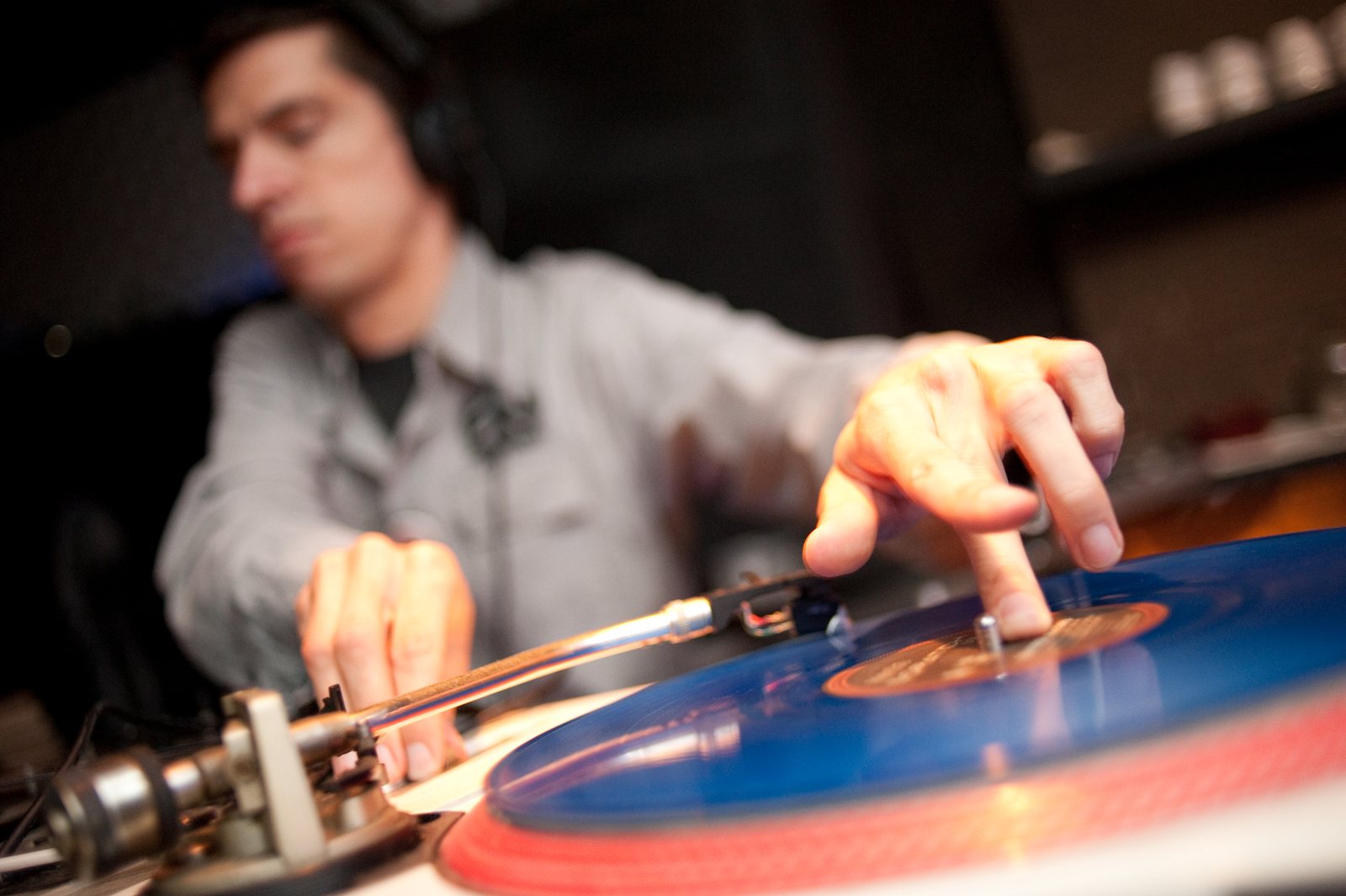
Scratching: rocking a record back and forth by hand on a turntable. It takes time before the movement feels natural (photo taken in 2010). Source: Photo by 黃 zero, CC BY-SA 2.0, Wikimedia Commons
All-in-ones that run from a USB drive without a laptop cost a tier more. AlphaTheta's XDJ-AN, announced in July 2026 to replace the discontinued XDJ-RR, is a two-channel unit priced at $1,199 in the US and ₩2.2 million on pre-order in Korea (DJ TechTools, DJ Korea Mall). There's little reason to buy one as a beginner. Think about it once you've put real hours into a controller and carrying a laptop has become a genuine chore.
What to get besides the controller
For headphones, go closed-back with at least one swiveling cup, since one ear listens to the speakers while the other listens to the next track. The AlphaTheta HDJ-CUE1 is a common beginner recommendation (Digital DJ Tips).
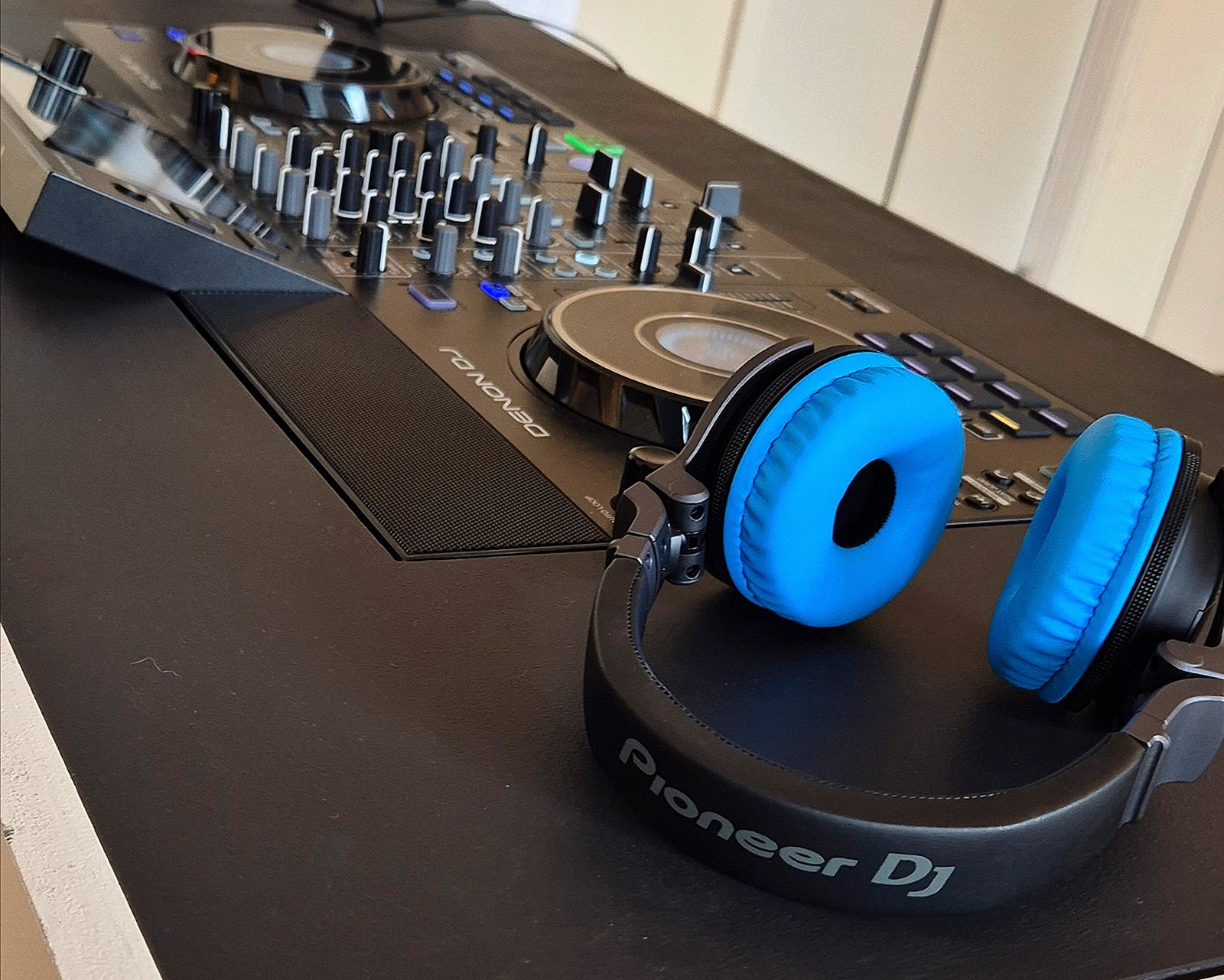
Pioneer DJ headphones resting on DJ gear. One ear listens to the speakers, the other to the next track (photo taken in 2025). Source: Photo by Djmichank, CC BY-SA 4.0, Wikimedia Commons 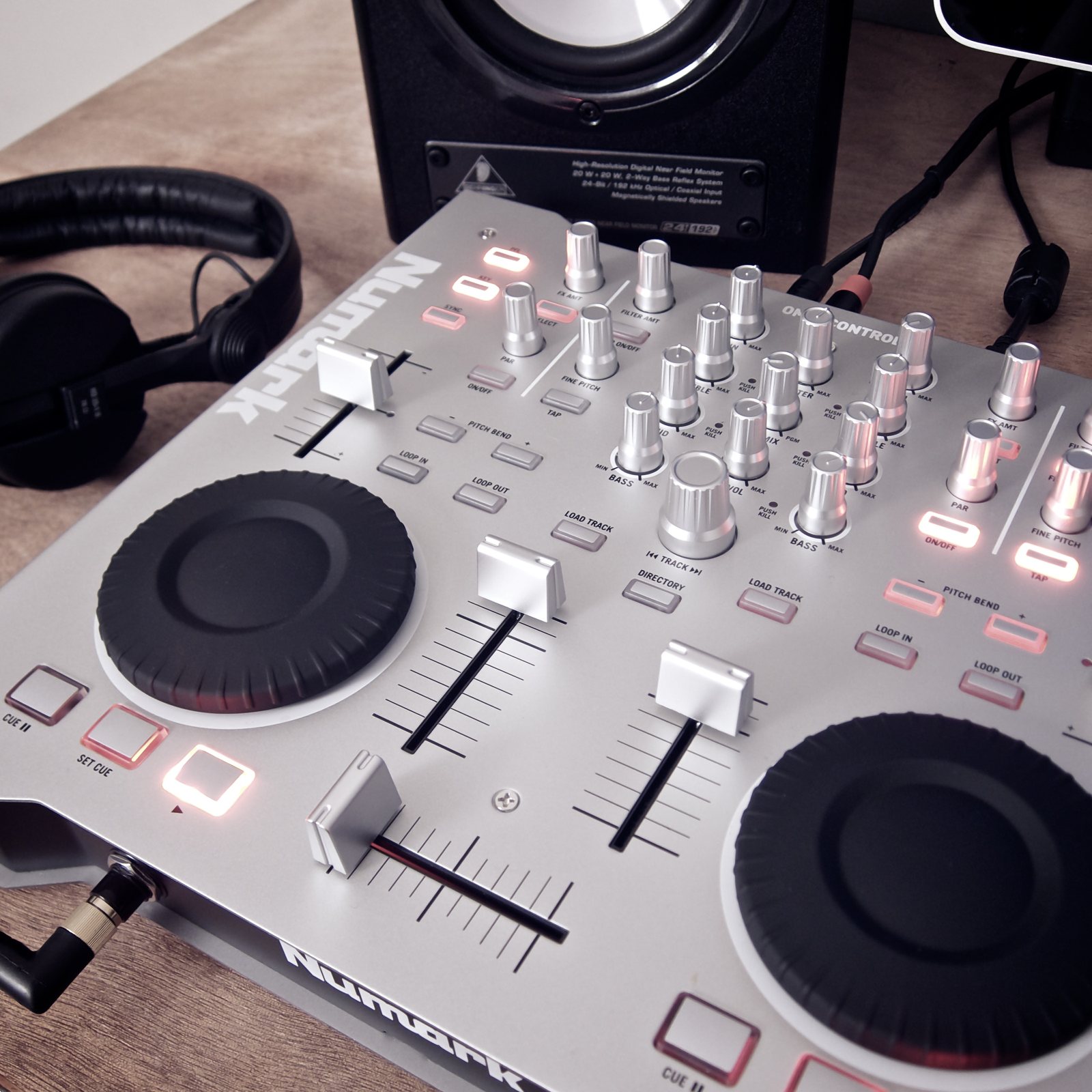
Controller, closed-back headphones and a small monitor speaker: a Numark Omni Control with Sennheiser HD 25s and a Behringer MS40 (photo taken in 2010). Source: Photo by Peter Hellberg, CC BY-SA 2.0, Wikimedia Commons
Skip Bluetooth speakers. The sound arrives more than 0.2 seconds late, which makes beatmatching impossible. For practice, your laptop speakers are actually better, and if you want a proper setup, use monitor speakers with a line input (Digital DJ Tips).
For music files, a 320 kbps MP3 or 256 kbps AAC is enough, and WAV or FLAC will do if you want lossless (Digital DJ Tips). Rips from YouTube are of doubtful quality and come with copyright problems (Serato). Get into the habit of buying from stores such as Beatport or Bandcamp from day one (Digital DJ Tips).
Last, levels. With the channel fader all the way up, raise the gain until the meter sits just below the red. Push past it and the sound distorts and can even damage speakers (DJ TechTools). On a controller without a gain knob, such as the DDJ-FLX2, set it in the software.
Your first month
Spend the first few days cut mixing for fun, switching straight to the next track with the fader on the first beat of a bar before the current one ends. It's fun, but it gets old in about a week. That's your cue to move on.
Next comes beatmatching by ear. Pick two songs you know well with similar tempos, play the current one through the speakers and the next one in your headphones, nudge its position with the jog wheel and set its speed with the pitch control. Digital DJ Tips advises trusting your ears over the BPM readout on screen, which can be wrong (Digital DJ Tips). Add the habit of counting phrases. A bar is four beats, and an instrument usually enters or drops out every eight bars, or 32 beats. Line up the start of each track's phrase and the transition becomes far smoother (DJ TechTools).
The sync button comes after that. Use it once you can match beats by hand, and be ready to fix things manually the moment sync slips (Digital DJ Tips). Records played by live drummers, such as 1970s disco and funk, drift slightly in tempo, so the software can't lay down an accurate beatgrid and sync is no help (Digital DJ Tips). Features that follow a wandering tempo now exist, such as rekordbox's Dynamic analysis mode and Lucid Beatgrids in Serato 5 (We Are Crossfader), but mixing those records still comes down to your ears. MagTAPE covered the debate over sync separately in "Is Convenience Good for DJing?".
Record your practice and listen back. Hear it a day later, away from the gear, and you'll catch slips you missed while mixing (Digital DJ Tips). Streamed tracks can't be recorded, so use music you've bought for sessions you plan to record.
Ears before lessons, practice before upgrades
You'll figure out what the buttons do on your own soon enough. Paid lessons earn their keep when you want to improve fast, need structure or want to refine a style of your own (Digital DJ Tips). Until then, your best teacher is listening, a lot. Put on sets by DJs you like and follow when the tracks change and which knob they probably turned. If you'd like to try gear before buying, DJ Korea's showroom in the I'Park Mall in Yongsan, Seoul, has several models on display (DJ Korea).
A starter controller hits its limits sooner than you'd expect. Once you're past cut mixing and beatmatching, you start missing a separate gain knob, bigger jog wheels, more channels and a layout like a club booth's. Upgrade then; it won't be too late. A cheap starter is also easy to let go of. Buying expensive gear before you've matched a single beat is spending money before you've put in the practice.
People say a good DJ isn't picky about gear. That's half true. A skilled DJ sounds good on a ₩159,000 controller. But when you choose your first piece of gear, there's one thing worth being picky about: three knobs on every channel.
Sources
- Beginner gear Hercules, DJControl Starlight · Hercules, Inpulse 200 MK3 · Hercules, Mix Ultra · AlphaTheta, DDJ-FLX2 · AlphaTheta, XDJ-AN · Pioneer DJ, DDJ-200 · Numark, PT01 Scratch · Allen & Heath, Xone:92 · DJ TechTools, DDJ-FLX4 (2022) · DJ TechTools, XDJ-AN (2026) · The FADER, Party Mix III (2026)
- Korean retail prices (checked November 19, 2026) ATOB Shop, Starlight · DJ Korea Mall, DJ controllers · DJ Korea Mall, turntables · DJ Korea Mall, all-in-ones · DJ Korea showroom
- Software and streaming Serato, DJ Lite · Serato, pricing · rekordbox, plans · rekordbox, Hardware Unlock · We Are Crossfader, rekordbox vs Serato (2022) · Lexicon · rekordbox, OneLibrary launch (2025) · Spotify, DJ software integration (2025) · Spotify, supported countries · Spotify support, terms of use · rekordbox, streaming service guide (2026)
- Technique and practice MusicRadar, EQ and filter tricks (2024) · Native Instruments, DJ transitions (2024) · DJ TechTools, gain staging (2015) · Digital DJ Tips, learning to beatmatch · DJ TechTools, phrasing (2014) · Digital DJ Tips, the techniques to learn first (2021) · Digital DJ Tips, tracks with drifting tempos (2017) · We Are Crossfader, Serato DJ 5 (2026) · Digital DJ Tips, is DJ training worth paying for?
- Headphones, speakers and music Digital DJ Tips, AlphaTheta headphones (2026) · Digital DJ Tips, speakers for DJing (2026) · Digital DJ Tips, music file formats · Serato, on rips (2016) · Digital DJ Tips, music download stores (2026)
- Photos All eight are freely licensed images from Wikimedia Commons, resized but not cropped: DDJ-400 with laptops (Nelsnelson, CC BY-SA 4.0) · DDJ-FLX4 practice corner (Marcel Glanz, CC BY 4.0) · Numark DM2002X (Jana C., public domain) · Allen & Heath Xone:96 (Vittjas Tief, CC BY-SA 4.0) · DDJ-REV1 (TaurusEmerald, CC BY-SA 4.0) · scratching (黃 zero, CC BY-SA 2.0) · headphones on DJ gear (Djmichank, CC BY-SA 4.0) · Numark Omni Control and HD 25 (Peter Hellberg, CC BY-SA 2.0). No usable freely licensed photos exist of the Starlight, Inpulse 200 MK3, DDJ-FLX2, Mix Ultra, PT01 or XDJ-AN, and product photos from manufacturers and retailers were left out because of their terms of use.
Comments
Loading comments…